
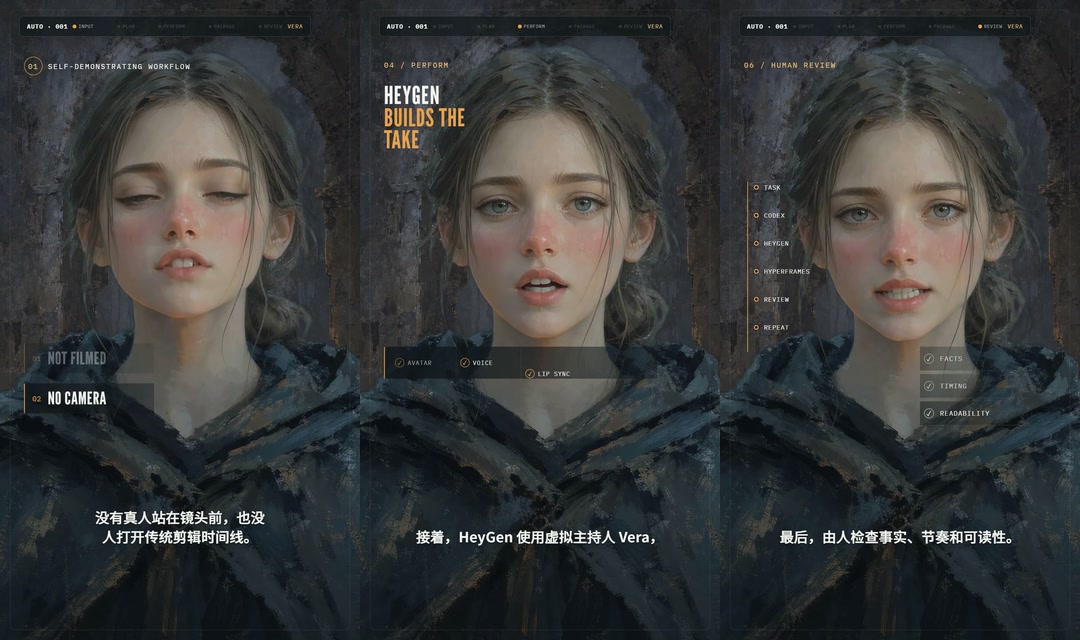
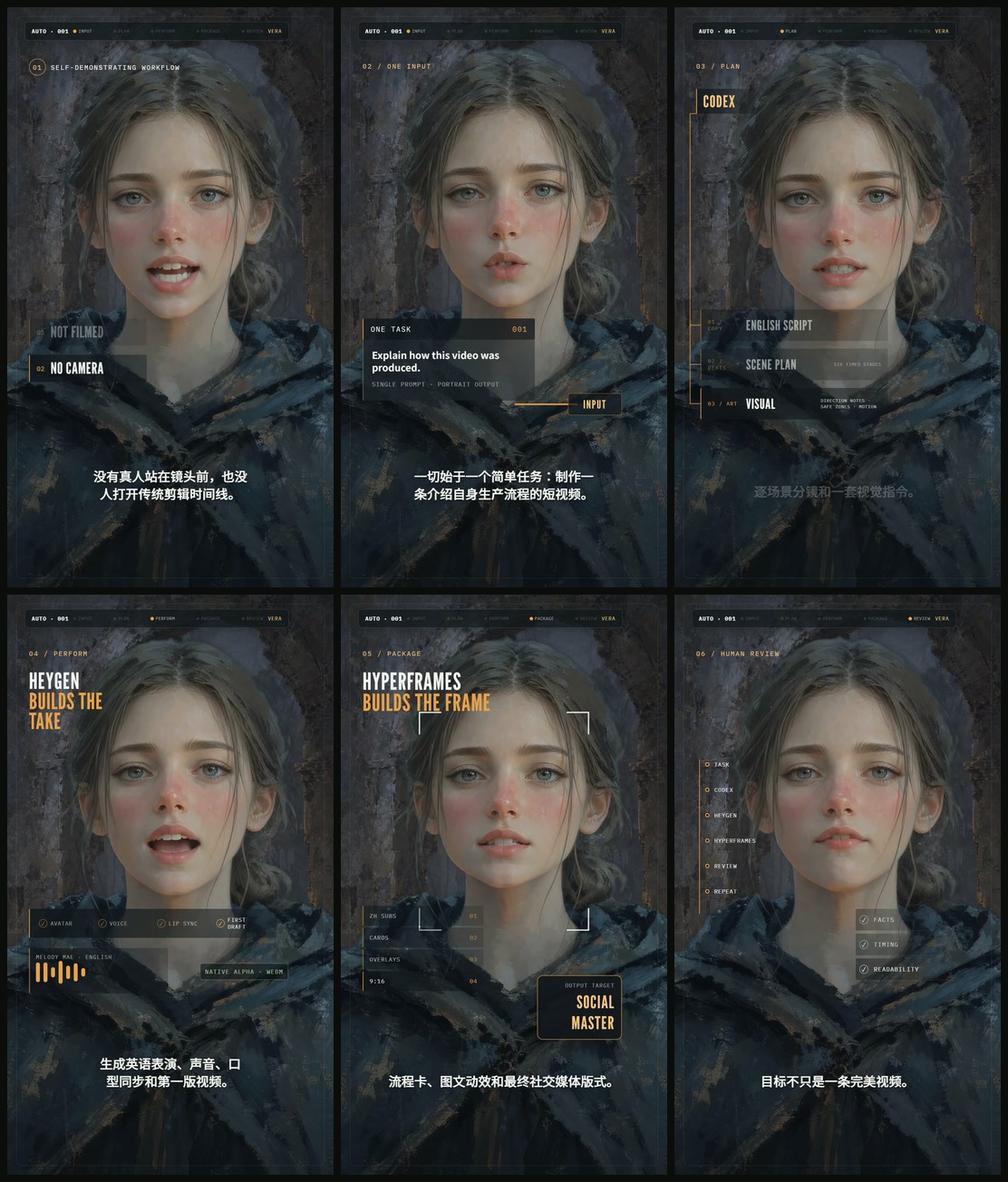
The subject of this video is deliberately self-referential: the video explains how it was produced. The content is simple because the real test is the chain behind it. I give Codex one assignment; it continues with the script, service calls, presenter footage, visual packaging, and a social-ready vertical master.
What emerged was not a perfect film from a single sentence. Tool operation became centralized, while direction became a clearer set of acceptance decisions.
The final division of labour
The approved workflow has three operational layers:
- Codex: planning and orchestration. It turns the topic into an English voice script, separates scenes, defines subtitle and graphic placement, calls the external services, and reviews keyframes and exports.
- HeyGen: presenter performance. It uses my existing Vera avatar to generate the English voice, lip sync, and base character motion. ElevenLabs was not used for this sample.
- HyperFrames: visual packaging. It combines the ruins environment, Chinese subtitles, workflow graphics, guide lines, transitions, and the final 9:16 canvas.
The final vote remains human: factual accuracy, cadence, face occlusion, readability, and whether the result is genuinely publishable cannot be delegated to automated checks alone.
Failure one: an avatar is not a character sheet
The first HeyGen source was a complete character sheet containing front and back views, portraits, full-body poses, and props. To a person it describes Vera thoroughly. To an avatar system it is simply one flat image to animate. The whole sheet became the apparent subject, so composition and facial performance could not work.
The fix was to supply less information: a clean, front-facing, chest-up vera1 portrait. The system then had only one question to answer—which face should speak? The full character pack is still useful for illustrations, environments, and additional shots, but it is not the right direct input for a talking avatar.
Failure two: animation is not direction
HeyGen is effective for a front-facing presenter, but it cannot infer a complete space beyond the source image. Backgrounds, props, major camera moves, and blocking should not all be forced into avatar generation. The reliable split is to let HeyGen produce the performance and let HyperFrames own the environment and information hierarchy. Walking, object interaction, or genuinely cinematic camera movement should be separate generative-video shots.
For this sample, Vera stays central against a painterly ruins setting that matches her design. Variation comes mainly from graphics, rhythm, and restrained reframing rather than pretending she occupies a fully navigable 3D scene.
The typography revision
The first packaging pass demonstrated familiar vertical-video failures: a long English label filled its container, too many cards competed at once, guide lines were ambiguous, and graphics covered Vera’s face. Chinese subtitles sat inside a heavy card that competed with the primary information.
The second pass shortened labels, limited line counts, enforced horizontal safety, moved graphics outside the face region, reduced simultaneous information, and removed the subtitle container. The improvement came from hierarchy and negative space, not additional effects.
- Background flash: a very brief yellow flash remains near one transition. It was not consistently reproducible in the editor preview, but it remained perceptible in human playback.
- Speech transition: pauses between Vera's long sections are more rigid than her within-section cadence. A direct silence-cut experiment made the joins worse, so the original timing was restored.
Why those two defects were left in place
They reveal that the repair was being attempted at the wrong layer. The flash cannot be judged only by an editor preview; the next video must inspect decoded source and final-encode frames around every scene boundary. Speech cadence should not be repaired by bluntly removing silence after the film is built. Shorter semantic paragraphs, explicit pause direction, separate takes, and auditioned transitions must begin at script and voice generation.
The imperfections therefore have value: the sample proves the system can finish a deliverable and establishes more precise gates for the next one.
What the test actually proved
“Codex is my only interface” is workable, but Codex behaves more like a global producer and execution director than a magic button. It can preserve avatar IDs, voice choices, caption rules, safe areas, service results, and the reasons for every rejection, then carry those lessons into the next brief. I still decide what sounds natural, reads clearly, and looks worth publishing.
The durable value of automation is not removing human judgment. It is turning each judgment into a reusable production rule.