
The capability boundaries of generative video are rarely stated directly. Vendor documentation describes what can be done, community tutorials present successful cases, and the question of which shots should not be attempted is usually answered only by spending time against the boundary yourself.
This article records one such collision—and a statistical review that could have prevented it.
First, the statistics: 228 prompts from five published workflows
The objective was to build a dependable pipeline for action shots. Before starting, I examined complete works that had already been published successfully to see how their creators approached the problem.
The sample comprised five complete public workflows. The largest contained 284 nodes and 411 connections. Extracting generation parameters node by node produced 231 video nodes and 228 prompts.
The first result matched expectations:
| Input mode | Nodes |
|---|---|
| Multimodal reference (multiple images guiding identity and scene) | 188 |
| Text-only generation | 43 |
| One image used as a strict first frame | 0 |
The median reference-image count was three. The pattern was close to “number of subjects in frame + number of essential props”: one or two images for an atmospheric single-subject shot, and seven to nine for a four-character ensemble.
The second result was unexpected. I counted action-related terms across the prompts:
| Category | Matches | Share |
|---|---|---|
| Attack verbs (swing, slash, chop, smash, pounce) | 41 | 18% |
| Two-subject interaction | 14 | 6% |
| Contact, impact, collision | 5 | 2% |
| Block, parry | 2 | 1% |
Attacks were described frequently; contact was almost absent. Inspecting the five apparent contact cases reduced the share to zero. Two prompts said that a palm should pass directly through another body on contact—a deliberately incorporeal effect. The remaining three involved a character colliding with a data stream or landing on the ground: character–environment collision, not character–character contact.
Not one of the 228 prompts from published work described physical contact between characters.
These were successful, released works. Their creators did not merely fail to depict contact; they systematically designed around it.
Then, the experiment: ten generations as counter-evidence
The target shot was a two-character combat sequence: a colossal stone construct attacks; a swordsman evades, counters, and blocks. It fell directly inside the gap identified by the statistics.
Across ten generations, seven classes of problem were corrected one by one. Each produced a repeatable cause-and-effect relationship:
- Turn-based staging — When the opening image is a static face-off, the result becomes an exchange in which each side waits for its turn. The repair is to begin with motion already underway.
- Style collapse — A separate style-description paragraph in an image-to-video prompt becomes a new synthesis target and displaces the source image’s visual language. The correct instruction declares inheritance (“preserve the reference image’s style”) instead of restating the style.
- Anatomical drift in a non-human subject — One forelimb of an arched quadrupedal construct stretched into a thin swinging appendage within a few frames. A negative instruction must identify the exact failure on the exact character; a generic list is ineffective.
- Reference-locked spatial distance — When the two characters stand far apart in the reference image, the model copies that layout. Writing “four metres apart” does not help because the model has no operational understanding of metres. An empty environment reference, with placement left to the action description, unlocks the composition.
- Action causality — To avoid character contact, the attack target was written as “the ground beneath the character.” The model obediently struck an unrelated patch of ground. The attack must aim directly at the character; the evasion is what makes it miss.
- Idle waiting — A twelve-second shot containing only three beats is padded with stillness. Intense combat needs roughly one beat every two to two and a half seconds, or about five beats in twelve seconds.
- Unnecessary endings — After completing the action, characters turn toward the camera and pose. This must be prohibited explicitly.
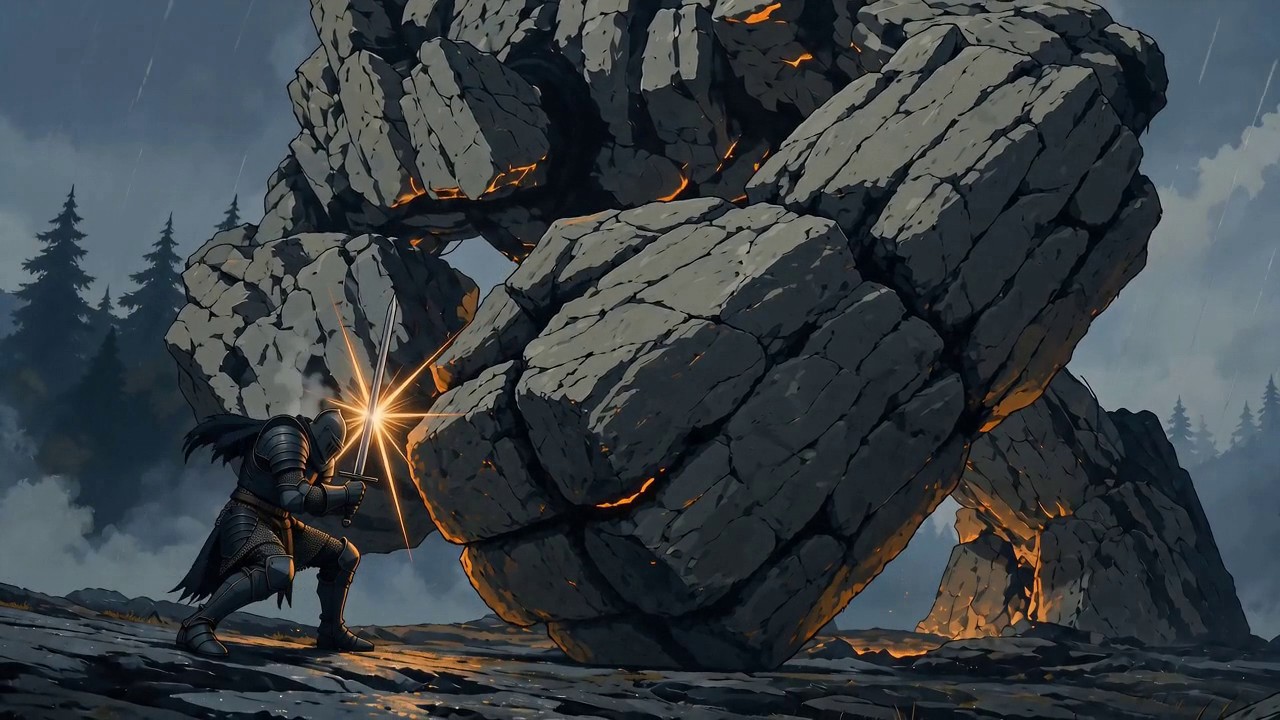
All seven corrections worked. Only one problem never did: the causal credibility between attack and evasion.
The pattern was stable. Both characters performed individually correct motions—the attacker swung and the defender rolled—but the attack trajectory never converged on the defender’s position. The result looked like “two people each performed an action,” not “one person moved in order to avoid the other’s attack.”
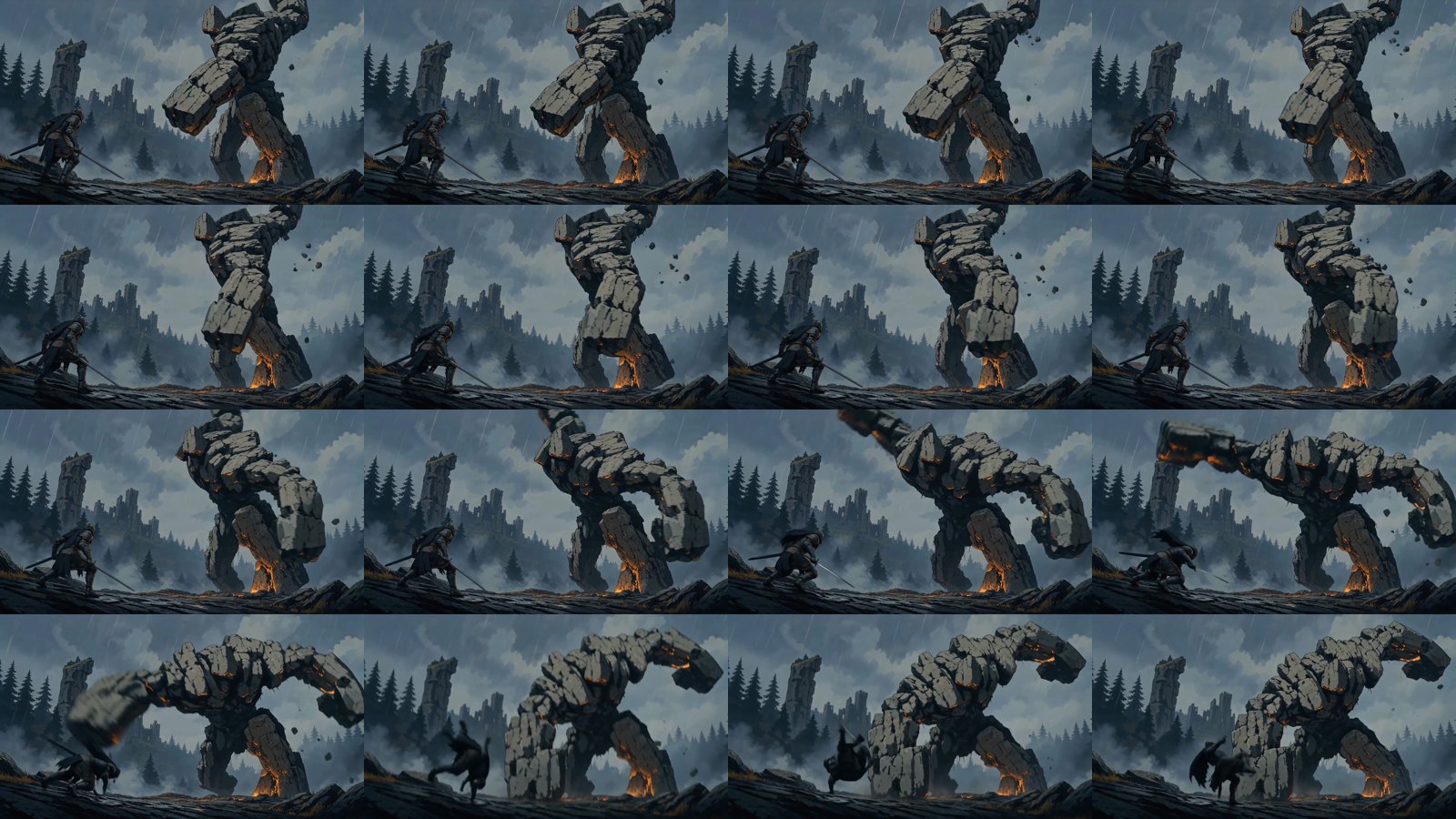
The project was stopped after the tenth generation.
Two methodological conclusions
Visual review through sampled-frame grids is systematically unreliable
Generated video is often evaluated through contact sheets. During this experiment, the same outputs received four successive corrections from the reviewing process: “movement present” when causality was absent; the wrong action label; “action absent” when it was present; and “style preserved” when it had already drifted.
The reason is straightforward: causality does not exist in any single frame; it exists between frames. A pose can be inspected in a contact sheet, but causality cannot. When the subject is an irregular, complex form close in colour to the background, even pose becomes hard to distinguish at thumbnail scale.
Two objective substitutes were tested, and neither worked:
- Motion trails from frame differences — Rain and camera movement fill the difference signal with global displacement. Global motion compensation would be required first.
- A texture metric based on Laplacian response — It can measure the distribution of high-frequency texture, but is insensitive to low-frequency characteristics such as metallic sheen and graduated highlights. It therefore misses the style problem identified clearly by a human observer.
The workable response is to narrow the scope of automated judgement. People assess action, causality, and style; software reports what can actually be measured—duration, resolution, bitrate, borders, colour statistics, prohibited elements, and whether parameters were applied correctly.
Written conclusions are not retrieved automatically
The retrospective produced another count: seven conclusions needed during this project had already been written in its own documentation but were not consulted. Each was remembered only after the corresponding failure. They included a controlled experiment whose content almost exactly matched the task, a style judgement recorded two weeks earlier, and three rules for action shots derived by the same team.
A parallel workstream driven by a different tool showed the same pattern. It had access to an 84-item knowledge base and still failed to retrieve it when needed.
The problem is not the amount or quality of documentation. Adding documents does not solve failure to look. A more promising approach may be to make retrieval the first mandatory operation in the workflow rather than something that ought to be remembered—for example, searching prior experiments and platform procedures before writing any prompt. This has not yet been validated.
Boundaries and limitations
The statistics cover five specific workflows by Chinese-language creators on the same platform, concentrated in urban fantasy and science-fiction shorts. “Nobody in the sample depicted character contact” and “character contact cannot be depicted” are not the same claim. The statistics support only the former. They nevertheless point in the same direction as three independent internal observations: blade contact in wide shots lacks pixel budget; contact often should not be shown directly for narrative reasons; and an adjacent workflow used shot names equivalent to “cut before contact.”
The standard way around the boundary is an impact cut: show the attack’s approach, cut, then show the result, with physical contact supplied by one to three manually approved still frames. The experiment described here ended before that method could be tested.
The conclusions are limited to the models used and the time of writing.