
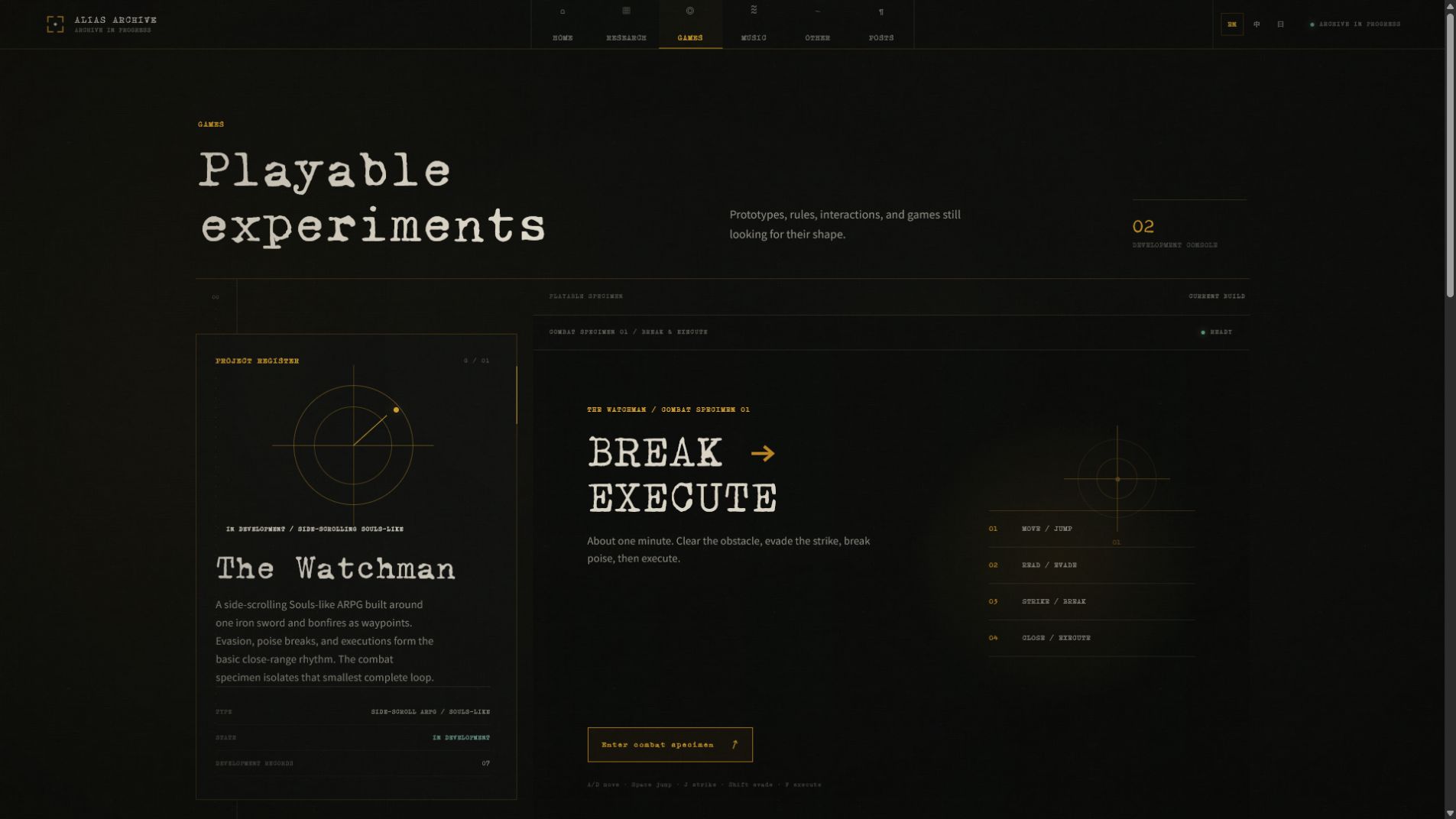
I wanted the Games page to contain something genuinely playable, but the goal was not to build a miniature edition of Watchman. A more useful approach was to extract the smallest complete combat loop from the main game: the character can move and jump, attack and evade; the enemy has poise and becomes executable after a stance break; roughly one minute of interaction is enough to communicate the basic rhythm.
The resulting demo runs directly in a browser. Visitors do not need Godot or a game client. Before it felt like the main game, however, it went through several familiar failures: the character walked backwards, attacks caused sliding, the enemy appeared to teleport, the platform blocked movement but could not be landed on, point-blank attacks dealt no damage, rapid inputs were occasionally dropped, and keyboard control still required an extra click after loading.
These problems all point to the same conclusion: when combat feel is ported, running is only the minimum requirement; the real test is whether the behaviour still obeys the contracts of the main game.
Objective: port one loop, not the whole game
The scope was deliberately narrow: a fixed level and attack value, one simple enemy, one raised platform, and six necessary actions—move, jump, attack, evade, break poise, and execute. The demo does not read saves or connect to quests, equipment, maps, or progression, and it does not share runtime scripts with the main game.
This serves two purposes. The web package remains small enough for static hosting, and the demo can be verified in isolation rather than silently depending on every future change in the main project.
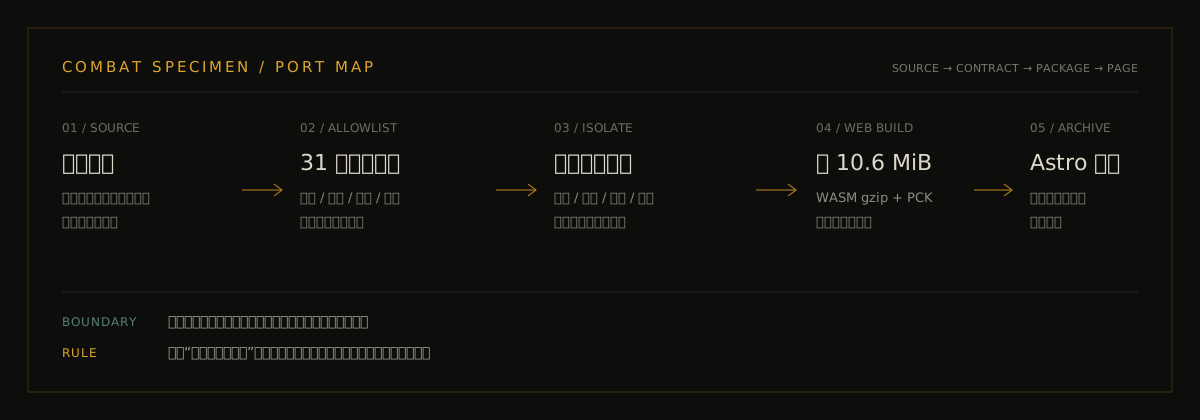
Isolation does not mean reinvention. The demo has a minimal scene and controller of its own, but animation assets, frame data, audio, typography, and essential combat rules still treat the main game as their source of truth. It is a slice of the game, not a second development branch.
Asset boundary: an allowlist, not a copied directory
Copying the project directory would have been faster and much harder to control. Unrelated resources, editor caches, and main-game scripts would enter the web package together, making it difficult to answer a basic question: what does this demo actually use?
The final solution is an explicit allowlist. The sync script copies only 31 items from the main project: player idle, run, jump, evade, attack, hit, and death animations; the small enemy’s animations and manifest; five forest background layers; the pixel font; and audio for swings, hits, breaks, rolls, death, growls, and execution. Nothing outside the list enters the demo.
This apparently simple file-management step establishes the most important engineering boundary. Every dependency can be named and inspected, then synchronized again when an approved source asset changes.
The first implementation: functional, but unlike the game
The first build ran quickly and exposed its problems just as quickly. The character faced the wrong way, movement carried inertia absent from the game, attacks slid across the floor, and landing on the raised platform left the player fixed on a crouched frame. The enemy shifted abruptly on contact, attacks failed at very close range, and one hit caused an excessively long stagger. Audio, damage numbers, and the existing pixel font were also missing.
These were not independent cosmetic bugs. They were the result of substituting familiar platform-game approximations for Watchman’s actual rules.
| Visible symptom | Underlying cause | Correction |
|---|---|---|
| Character walks backwards | Sprite-facing convention differs from the generic assumption | Read and preserve the main game’s orientation rule |
| Attack causes sliding | The attack state does not own horizontal movement | Freeze or constrain movement according to the main state |
| Enemy appears to teleport | A blocking body collision was added even though the game has none | Remove body pushing; retain only hit and hurt interactions |
| Platform cannot be landed on / landing freezes a crouch frame | One-way platform, landing detection, and animation state are entangled | Separate landing logic from animation-state changes |
| Point-blank attack misses | The hit test relies too heavily on facing and centre distance | Use attack reach and allow zero-distance overlap |
| Every hit causes a long stagger | The player’s poise contract was omitted | Restore poise and shorten ordinary hit stun |
If a prototype is playable but does not feel like the main game, stop polishing it. Return to orientation, state timing, collision layers, attack reach, poise, and movement rules; do not cover an incorrect premise with more patches.
Returning to the source: extracting combat contracts
The repair no longer worked backwards from the demo’s appearance. It compared each behaviour directly with the main project. Character animation returned to the existing frame data and foot anchors. Movement during attacks, hitstop, and knockback were arranged around the original state logic. Blocking body collision was removed from the enemy, allowing the two characters to approach and overlap; contact matters only when an attack actually lands.
Poise returned to the loop as well. Ordinary hits reduce it without placing the target in a long stagger every time. Only when poise reaches zero does the enemy enter a broken state and become executable. Execution detection is wider than ordinary attack reach: pressing X makes the player approach the performance position automatically before the execution begins, rather than demanding pixel-perfect placement.
Rapid attacks received an input buffer of roughly 0.35 seconds. If the player presses attack again before the current animation is finished, the command is retained and triggered when the follow-up window opens. The buffer does not make the combo faster; it prevents a valid rapid input from disappearing between frames.
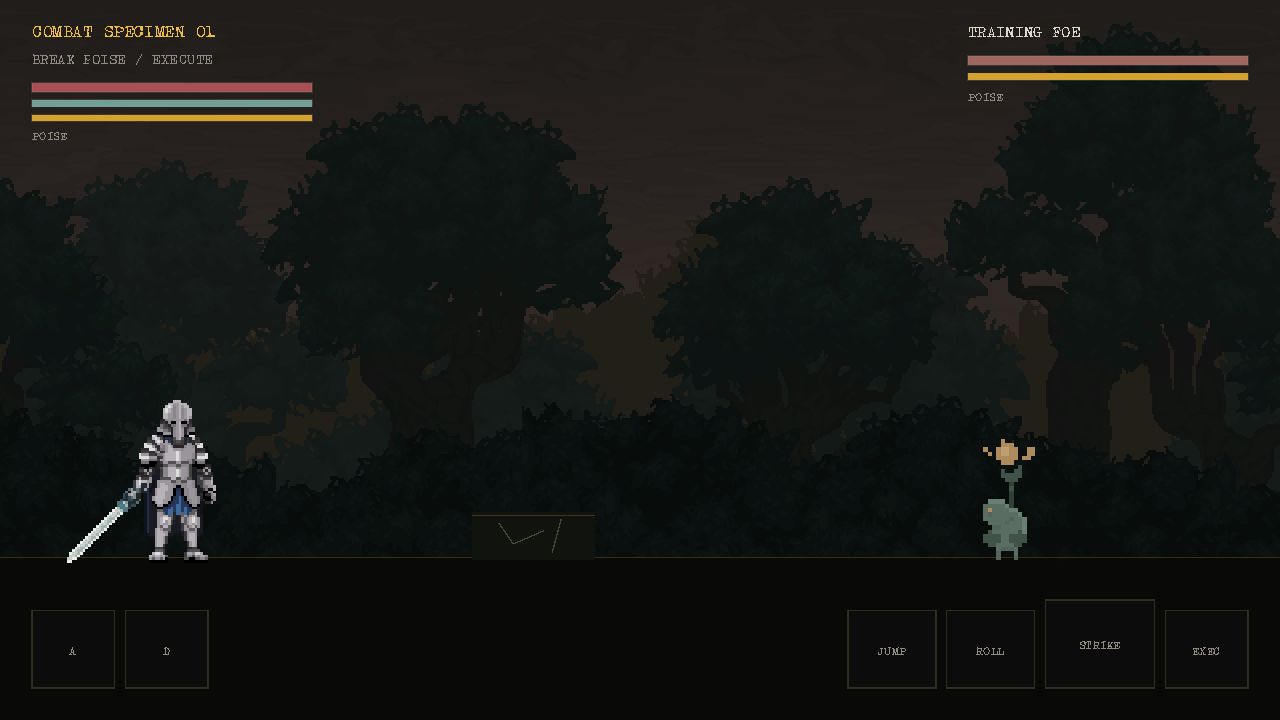
The main game’s audio, damage numbers, and pixel font were also restored. Their earlier absence was not a limitation of the web platform; they had been treated incorrectly as decoration to add later. Swing audio, hitstop, floating values, and letterforms all participate in feedback. Removing any one of them makes the action feel thinner.
Web packaging: placing the engine behind the archive
Once isolated, the Godot scene exports as a browser-executable Web build. The current package contains seven files and is about 10.6 MiB. Its WebAssembly body is distributed as a gzipped static file and decompressed locally through the browser’s DecompressionStream. Visitors need only a modern browser with WebAssembly support; Godot does not have to be installed.
The Games page does not download those 10.6 MiB on arrival. It first presents an archive-style launch panel. Only after the visitor chooses to enter the combat specimen does the page create the iframe and begin loading. People who do not play incur no game-resource cost, and the page’s initial render remains independent of the engine.
Godot’s native loader is hidden behind a loading bridge that matches the archive. The outer page listens to real download progress and displays the current package and percentage. When the inner engine finishes initialization, it sends a ready message through postMessage, and the page reveals the canvas. Failure retains an explanation and retry path instead of ending on an unexplained black screen.
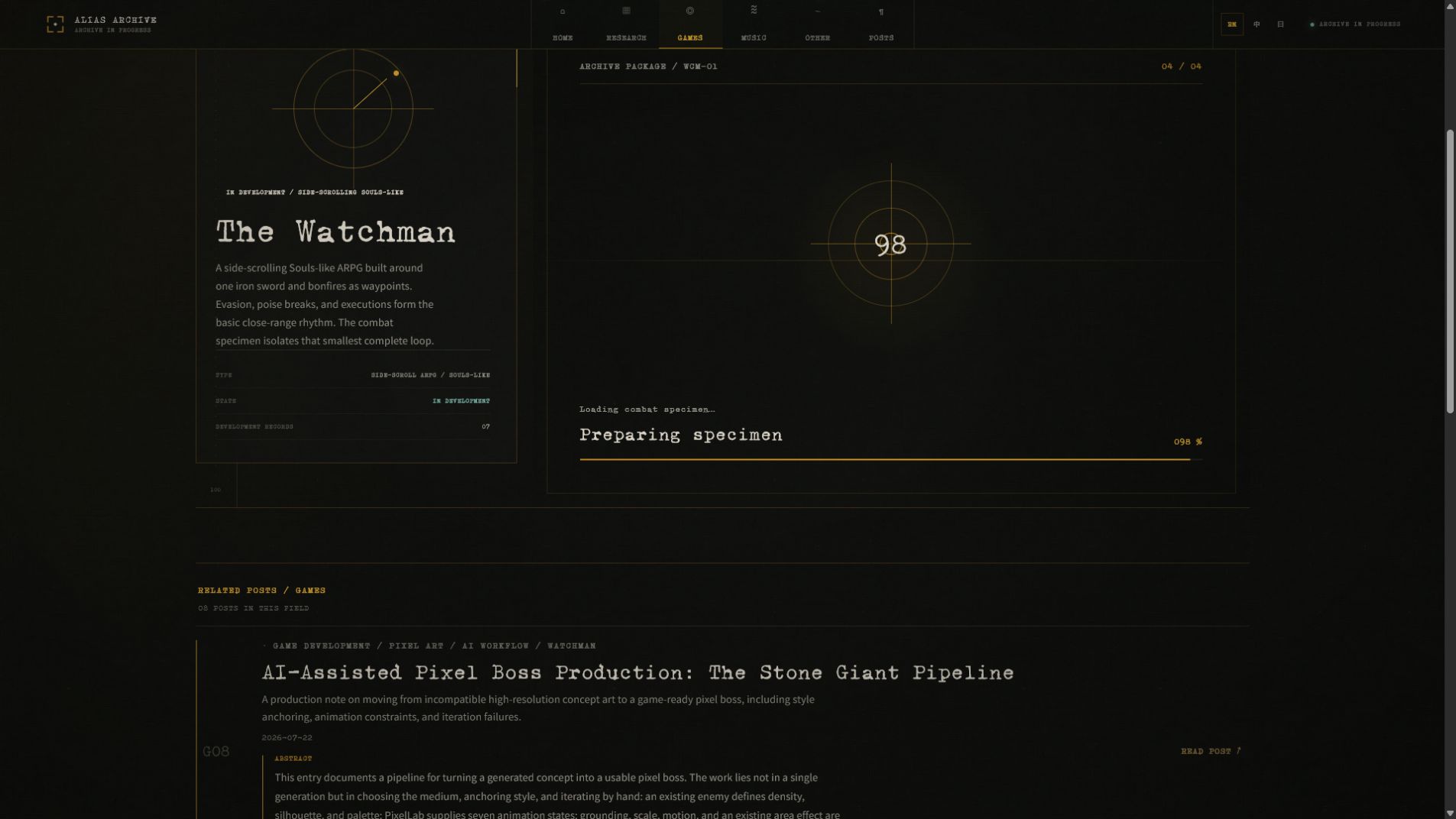
The last issue occurred after loading had already succeeded. On desktop, keyboard input did nothing until the game frame received another mouse click because focus remained in the outer page. The ready signal now transfers focus to the iframe, and the inner page explicitly focuses the Godot canvas. The original launch click can therefore continue naturally into game control.
Verification: automated boundaries, manual feel
No single kind of test is sufficient here. Build and automated checks verify resource paths, static output, page states, and the message bridge. Desktop and mobile previews cover dimensions, fullscreen behaviour, scrolling, loading failure, and keyboard focus. Movement, attack timing, point-blank hits, platform landings, stance breaks, and executions still require continuous hands-on play.
The most valuable reports were the ones automation finds difficult to phrase: “movement has inertia,” “the attack slides,” “the enemy looks like it teleports,” and “the execution range is wrong.” These are not vague opinions. They are difference reports between the main game’s feel and the port. Translating each difference into a state, collision, or timing problem is what completes the port.
The second pass after deployment: controls must suit the web
Completing a round on desktop did not mean the demo was ready for public use. Testing the deployed build on a phone exposed a different class of failures: the fullscreen control appeared to do nothing; the completion screen said “tap to restart,” but tapping did not restart; desktop controls lacked clear shortcut labels, while the mobile labels became illegible because too many buttons competed for space. A separate failure was less obvious—the deployed build loaded correctly while the local development page remained at 3 percent.
The 3-percent stall was not one recurring bug. One instance came from Godot 4.7’s stricter script type-inference checks and had to be eliminated before export. Another came from a difference in directory-URL handling: Cloudflare Pages resolved /game/watchman-demo/ to the entry document, while Astro’s local development server did not guarantee the same behaviour. The iframe now requests /game/watchman-demo/index.html explicitly. The lesson is that “it works in production” and “the integration is correct” are not equivalent conclusions. Engine export, the development server, and the final host each require their own check.
Mobile fullscreen could not rely on the native Fullscreen API alone either. Once an iframe is involved, phone browsers impose different restrictions on fullscreen, orientation, and user activation. The page now falls back to a page-level pseudo-fullscreen layout when native fullscreen is unavailable and always retains a visible exit path. The fallback does not pretend to be system fullscreen; it first guarantees a usable canvas, control area, and way out.
“Tap to restart” revealed a classic mismatch between interface promise and input implementation. The first revision changed the wording, but touch detection still listened only to the small rectangle occupied by the attack button. Tapping the completion card naturally did nothing. In the corrected version, the completed state intercepts any new touch or mouse click before ordinary controls and resets the encounter. The active area now matches what the screen communicates.
| Symptom | Actual cause | Final treatment |
|---|---|---|
| Local loading stalls at 3 percent while production works | Export checks and directory-entry resolution differ | Validate the script before export and request index.html explicitly |
| Mobile fullscreen appears unresponsive | Embedded native fullscreen is inconsistent across phone browsers | Add a page-level fallback beyond native fullscreen |
| “Tap to restart” does not restart | The copy refers to the whole result screen, but code listens to one button | Allow any new click to reset while complete |
| Too many small, duplicated controls | Main-game and debugging keysets were carried into the specimen | Redesign input for this specific web loop |
The final mapping no longer tries to imitate the complete game. Arrow keys move, Z or Space jumps, Shift evades, and X is the single contextual action. X attacks during ordinary play; after a stance break, the same key starts the automatic approach and execution; after completion, it restarts the encounter. Mobile therefore contracts to five touch areas—left, right, jump, evade, and contextual action—while the action label changes between STRIKE, EXECUTE, and RESTART.
Simplifying input does not remove combat mechanics; it transfers contextual judgment to the state machine. A web demo does not need to expose the full game's complete keymap. It needs the smallest clear control set that lets the same loop finish—and restart—on both keyboard and touch.
This pass also completed the validation sequence: run Godot’s headless script check and Web export first, then the production Astro build and static tests; inspect the direct entry point, embedded page, and Cloudflare deployment separately; finally complete a round on a real phone. Automation can prove that files and message bridges remain connected, but only device use reveals a button that is visible yet inoperable.
Conclusion: a demo as a specimen of combat contracts
- Reduce scope, not rules: retain only one loop, but source every behaviour inside it from the main game.
- Admit assets through an allowlist: keep size, provenance, and update paths inspectable.
- Resolve presentation failures at the contract layer: orientation, collision, poise, input buffering, and execution movement cannot be approximated by appearance.
- Make the engine obey the web experience: lazy loading, real progress, recovery, and focus handoff are part of the demo itself.
- Automation protects engineering boundaries; manual play decides whether the feel survives.
The value of the web demo is not merely that the website now contains a game. It separates Watchman’s smallest set of combat contracts from the complete project and forces every implicit rule to become explainable, testable, and deployable. As the main game changes, the specimen can remain a direct comparison point—not a showcase of everything, but a check that the most basic combat rhythm still holds.