
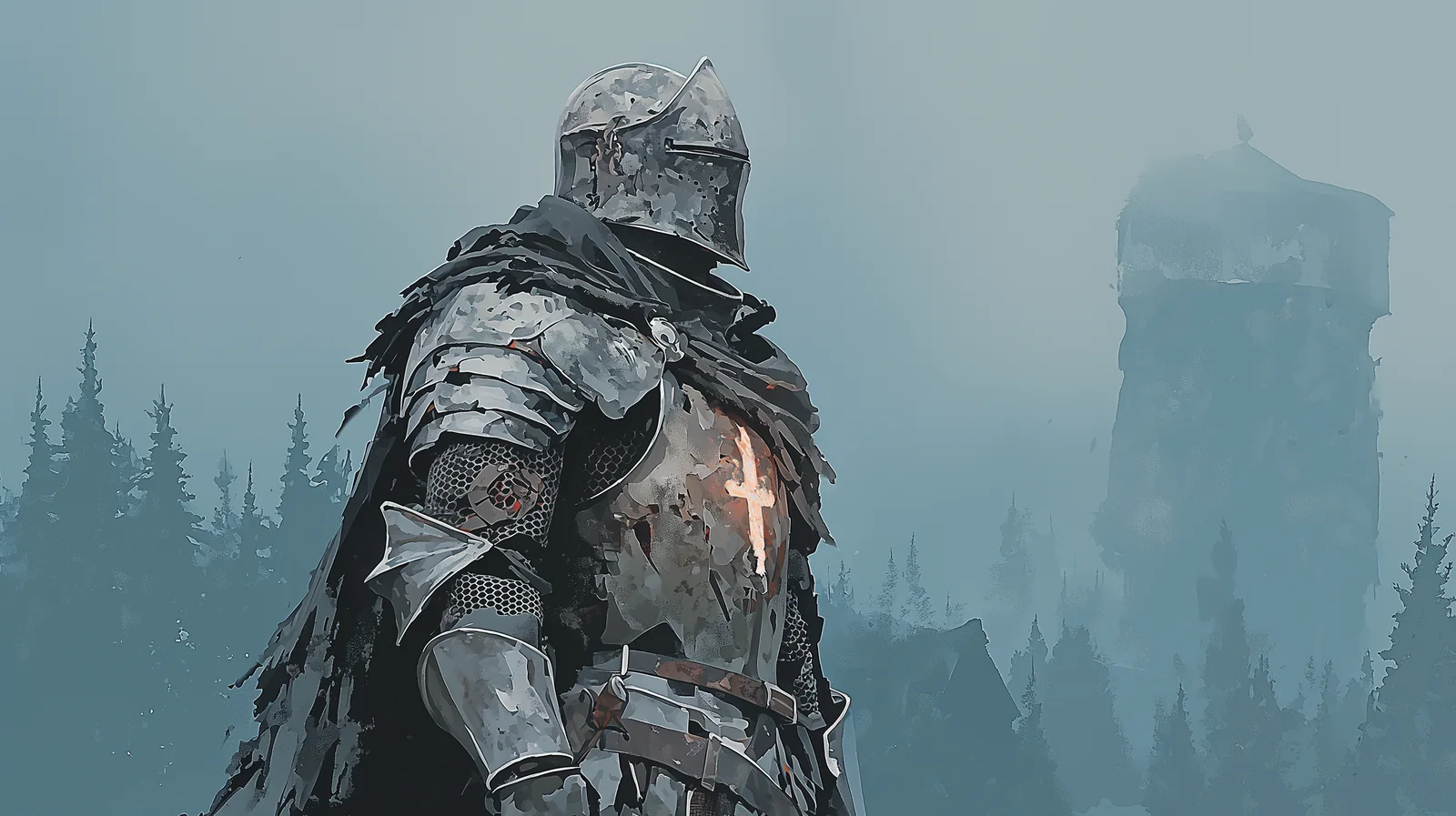
The perceived weight of Soulslike combat does not come directly from damage values. The more important experience is the continuous sequence in which the player maintains pressure, causes a boss to stagger, breaks its stance, and completes an execution within a short opening.
Watchman’s central combat rhythm is built around that sequence of feedback.
Weight comes from pacing, not values
The current target for a boss encounter is to last between thirty seconds and one minute under sustained effective damage, and end after two or three stance breaks and executions.
Three systems support this target:
- Stance meter: every enemy has a hidden stance value that is reduced by the player’s attacks;
- Stance break: when stance is depleted, the enemy enters a clear stagger and an attack window opens;
- Execution: the player can approach during that window and perform a high-damage execution. It is both a numerical peak and the release point of the encounter’s emotional pacing.
Combat is therefore not simply a comparison of health pools. It asks the player to control the rhythm under pressure and secure two or three decisive breaks. The sense of weight is produced by this offensive and defensive structure, not by larger values alone.
Encoding durability in base values
An early version attempted to make elites and bosses more durable through multipliers. The result tended to alternate between weak feedback and excessive health.
The revised approach writes target durability directly into the base values. The overall scale was reset with Souls titles as a reference, while multipliers were retained only for local adjustment. The intended combat duration and number of stance breaks first determine how many effective attacks a boss should withstand; the values then implement that design rather than amplifying it through a uniform multiplier.
Turning speed and positional strategy
Enemy turning speed is also an independent attribute. Small enemies turn quickly to maintain mobility and pressure. Large enemies turn more slowly, creating a clear opportunity to move behind them. Attacks from the rear deal greater stance damage, making positional movement a practical tactic rather than a visual variation.
Distinct rewards for parries and executions
In addition to sustained pressure and stance breaks, the player can use a parry. Its timing window is shorter than an ordinary guard. A correct parry deflects the attack and places the enemy in a longer stagger. Executions reward sustained pressure; parries reward recognition of an enemy’s action. Together, they provide offensive routes with different levels of risk and return.
Frame-by-frame testing of combat feel
These systems provide only the combat framework. The final feel depends on specific timing values: the duration of a stance-break window, the startup frames of an execution, and the width of a parry check all require repeated comparison in play.
For that reason, combat feel is not finalized autonomously by AI. AI can assist with system implementation and parameter organization, but I test every critical window frame by frame and make the final decision myself.