
This is the production record for Eight Sins × Sixteen Types: one 90-second main film and sixteen one-minute shorts, made over two days. The method follows the workflow of this series of shorts: every frame is determined by time alone, a web canvas is captured frame by frame and encoded, and the music is synthesised with numpy. The animation, scores and checking tools were written by Claude Code; I chose the topic, watched the cuts and made the calls. Every “feedback” in this record is a note I gave after watching.
Starting point: sixteen cells
The idea was simple: seven sins plus seven virtues make fourteen, and two more make sixteen, exactly matching MBTI. The way to add them was to make the seven sins eight. The eight evil thoughts listed by Evagrius in the fourth century include “vainglory”, which later lists folded into pride, so it could be brought back as the eighth sin; for its contrary virtue I chose “sincerity”.
At first I worried that matching a type with a sin would be unfair. Later I decided there was no need: today the seven deadly sins often read as cooler than the seven virtues, and people enjoy laughing at themselves. The real problem was that stereotypes are too strong, and the answer was to give each type a radar chart, so viewers can see that a type is more than one sin.
One card first
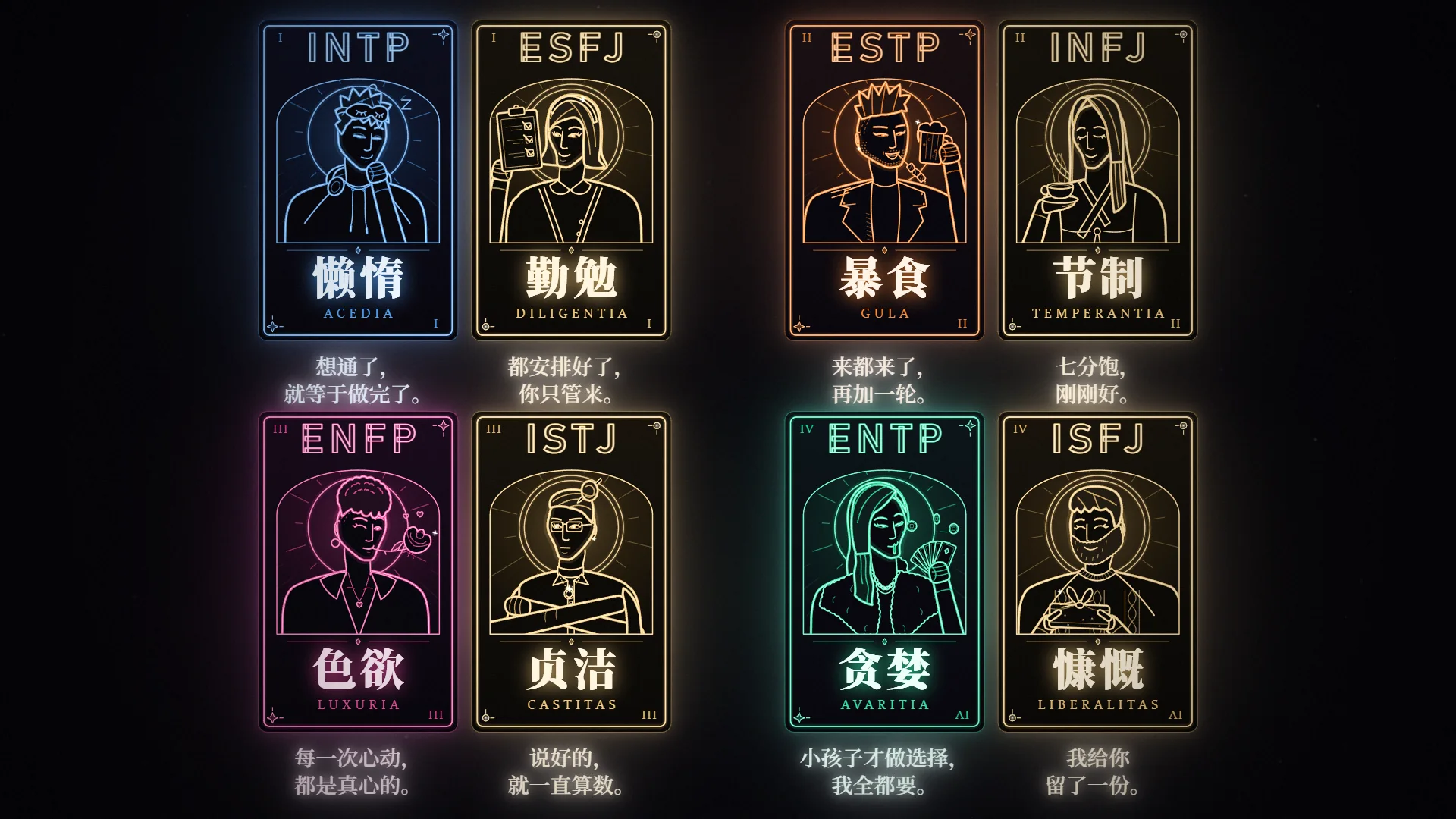
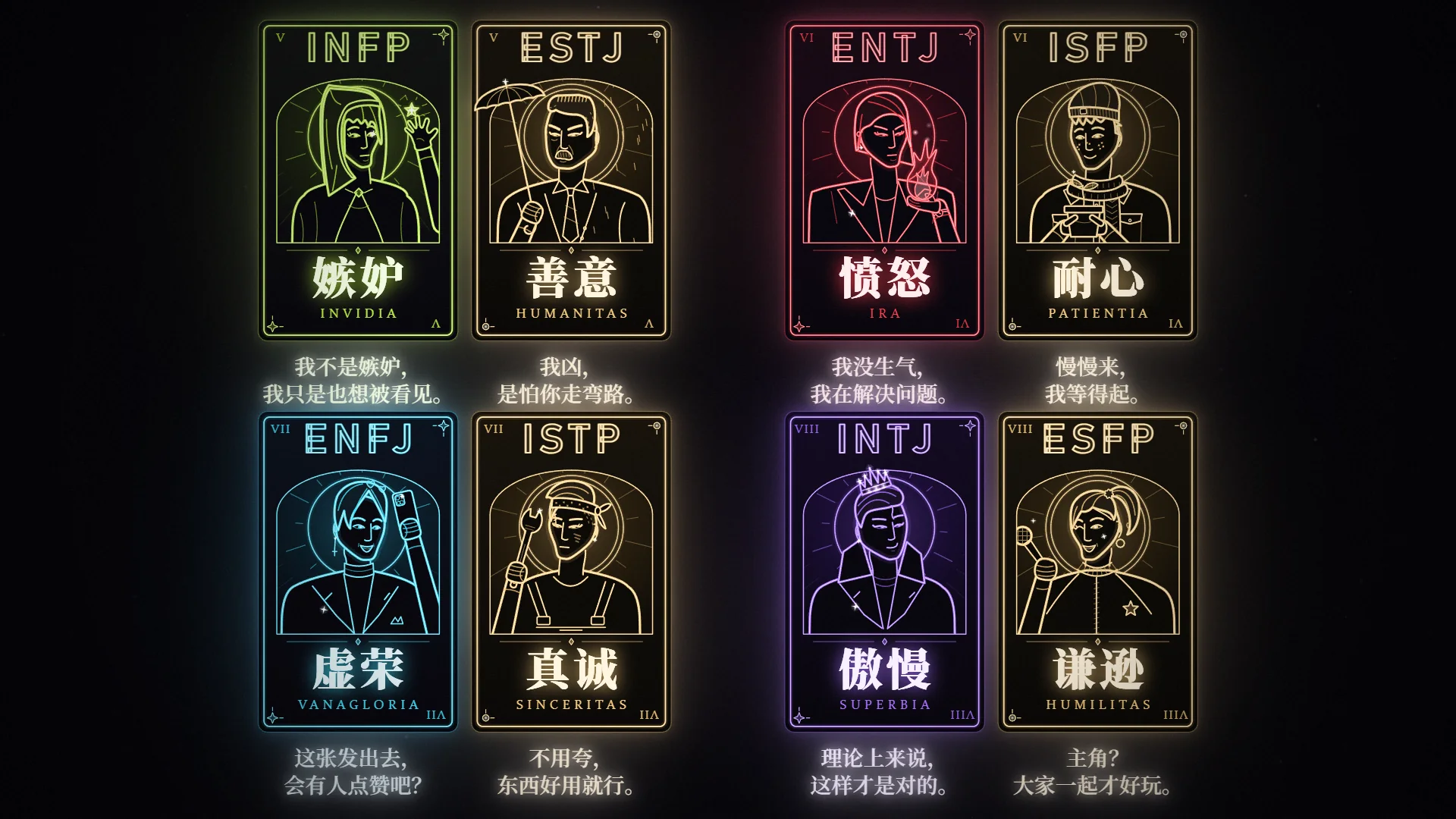
Before making the whole film, I made only one pair: INTJ’s pride flipping to ESFP’s humility, 12 seconds long. The look became neon tarot cards on a dark ground: the type letters are neon tubes, an arched window holds a line-drawn figure, and below are the sin’s name in large type and its Latin. A sin card takes that sin’s colour; a virtue card is white gold.
The figures are not drawn by hand but assembled from parts: head angle, eyes, eyebrows, mouth, hairstyle, clothes, arm pose and prop are all parameters. Completing all sixteen types meant adding parts and sixteen sets of parameters: fourteen hairstyles, eight arm poses, and one signature prop per sin.
After watching the test, I raised two problems.
The radar chart could not be read. In the first version the radar chart flashed through the card, fully lit for only a second, and overlapped the card’s lines and large type. It was moved to the right of the card, where the whole chart stays on screen and turns half a circle with the flip; the other labels drop back to grey, and only this card’s item keeps its colour. The axes were also reordered to put similar sins next to each other, which cut the average number of spikes across the sixteen charts from 5 to 3.75, so the direction a chart leans can be read at a glance.
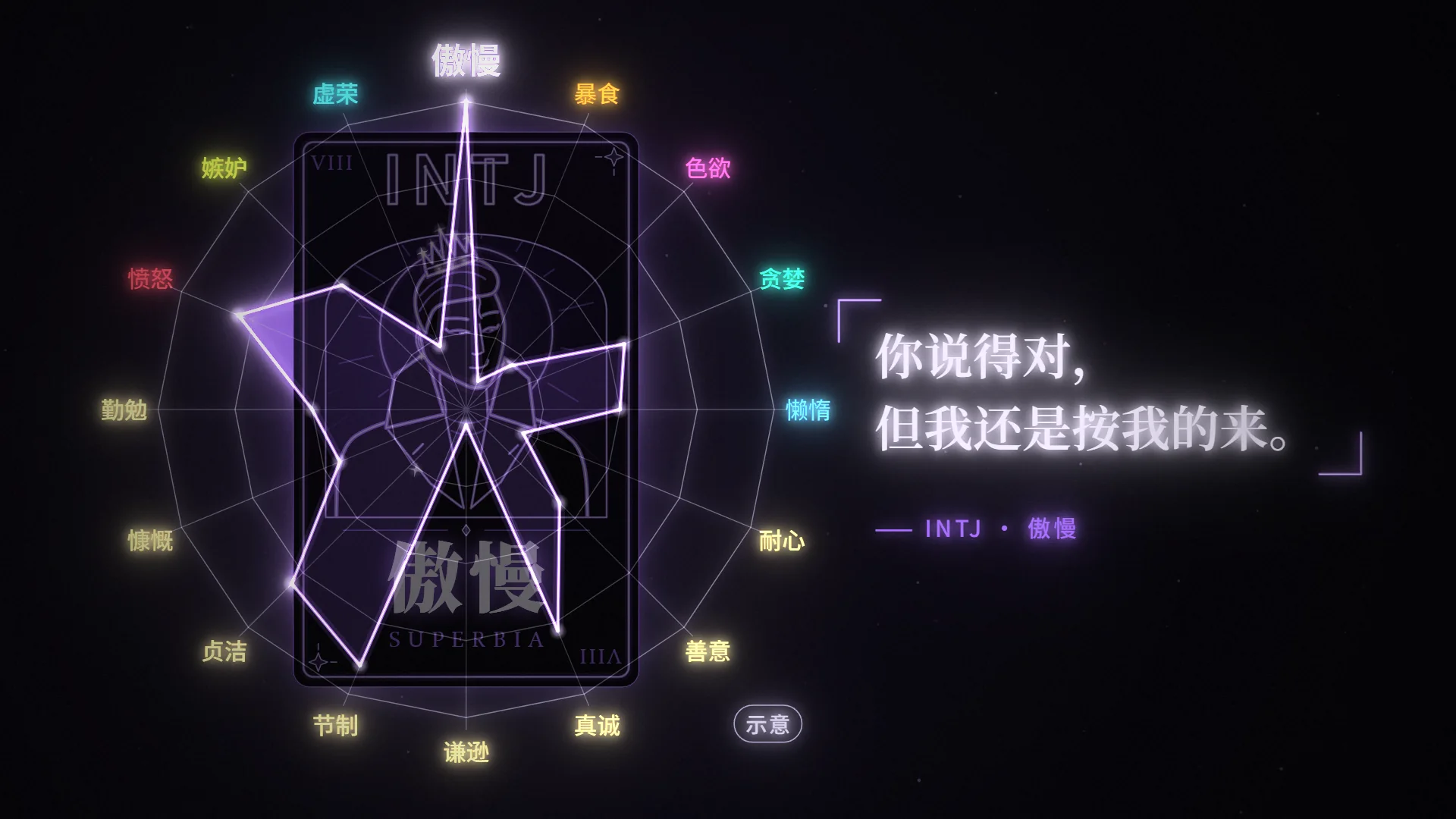
Later a second lamp was added: a sin card also lights the type’s strongest virtue. The gold “temperance” then shone brighter than the purple “pride”, because gold is naturally brighter on black. So the two were ranked: the card’s own item is enlarged, brightened and given a glow, and the other is made smaller and darker.
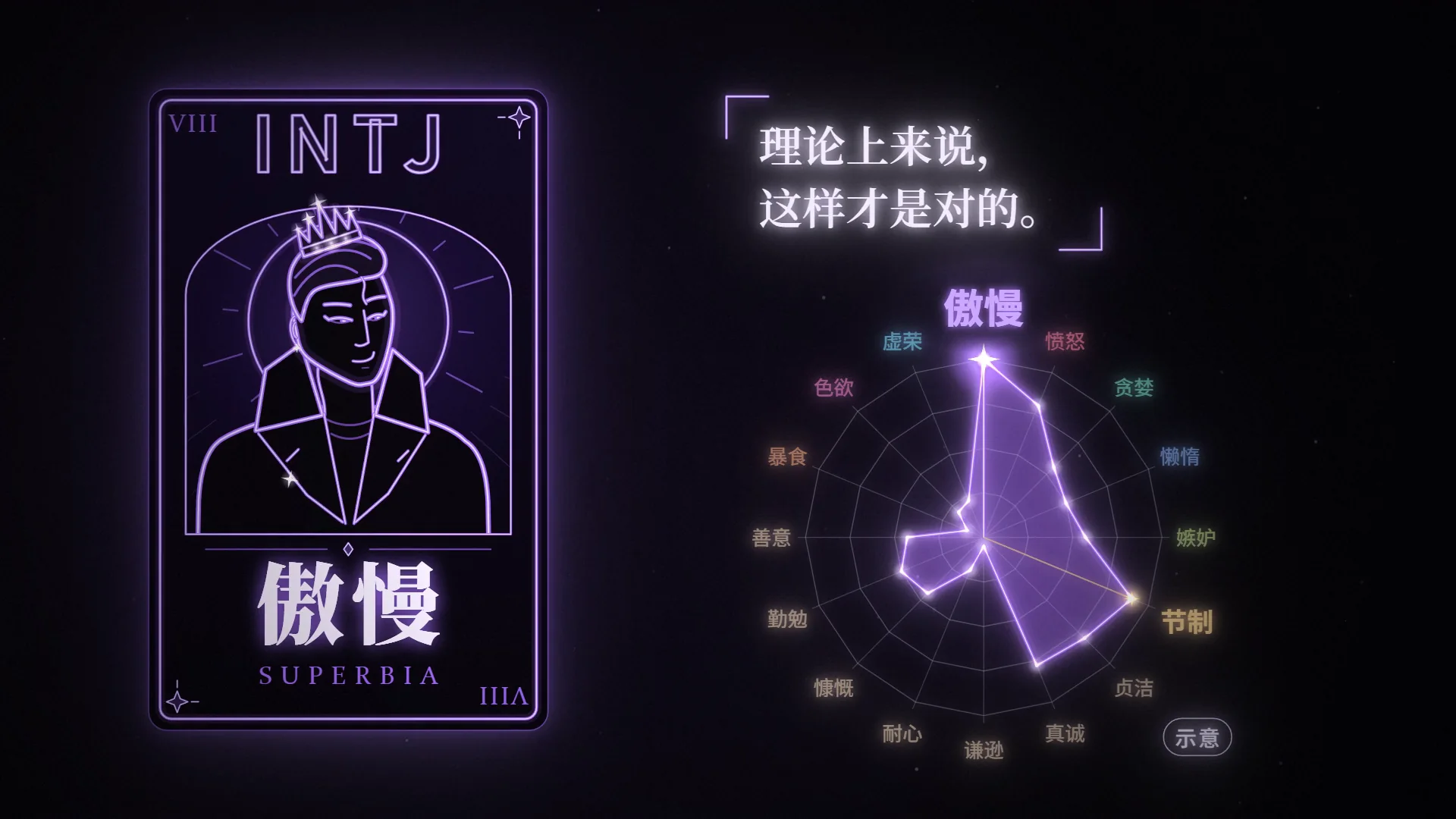
The lines did not sound right. INTJ’s original line, “You’re right, but I’m still doing it my way”, read as blind stubbornness, not as INTJ. I replaced it with my own catchphrase: “Theoretically speaking, this is the right way.” The other seven sins’ lines were rewritten on the same principle: something the type itself finds perfectly reasonable, not a flaw.
Dropping “antidote”
The test originally ended with “Your sin: the antidote is on the other side”, and a beam of light joined the two cards. To me “antidote” read as “go and find that type to pair up with”. The word was dropped altogether in favour of “two sides of one card”: the ending now flips the same card back to its sin side on the downbeat, then over to its virtue side, with “Your sin, turned over, is a virtue.” The beam between the two cards went too, because it also looked like matchmaking.
One timing sheet, made in two halves
The picture and the score of the main film were made by two tasks at the same time, held together by a bar-by-bar timing sheet written first: 120 BPM, two seconds per bar, 45 bars making exactly 90 seconds. The sheet marks the second of every downbeat and whether it is a card slam (impact), a flip (bright) or the close (final), as well as where the 16 plucked notes of the opening and the pentatonic ratchet of the slowing wheel at the end fall.
When both halves were finished they were simply joined: the picture’s flashes and the sound’s attacks were all within 5 milliseconds of each other. Changing the score later did not require re-rendering the picture, only swapping the audio track.
The score changed twice
A dropout before every hit. In the first version the music cut out for a sixteenth note before every downbeat, so that the hit landed harder. Heard once it works, but coming every four seconds it felt halting. Now ordinary downbeats have no dropout, only a reverse-cymbal swell; real silence is kept for one place, just before pride appears.
Silences that cut off. Before the wheel stopped at the end, and before the last line, there was a silence each. The music fell from full volume straight to zero, which on its own sounded like a truncated file. It was changed to wind down first and stop after: drums and bass leave first, the pad sinks and darkens like a slowing tape, and only an ever sparser ratchet remains; before the last line there is no silence any more, but a snare roll pushing in. Nobody found the silence before pride odd, because a crescendo leads into it and the pause is heard as intended.
Two rounds of fact-checking
Every short tells one historical fact, so each was sourced separately. Corrections made over the two rounds:
- “Gregory the Great folded vainglory into pride” was an error in the first draft. Gregory still listed vainglory first among the seven, with pride above the seven; vainglory was folded into pride by the standard lists from the 12th century on. Many Chinese and English sources repeat this error.
- The five kinds of gluttony, “too soon, too expensively, too much, too eagerly, too daintily”, come from Gregory in content, but the one-line mnemonic was composed later; Aquinas records it.
- The line Aquinas quotes, that whoever is not angry when there is cause sins, is not by John Chrysostom but from a pseudonymous fifth-century commentary. The film quotes only Aquinas’s own view.
- The historian Little argues that greed caught up with pride after commerce rose, but the view is contested, so the film says “some historians argue”.
- A better point turned up: in 1340 the English word luxury meant lust, and only in the 17th century did it come to mean extravagance.
- The seven virtues are often said to come from the Psychomachia, but they match it only in part; the tidy list is closer to the 19th-century Catholic catechisms.
From eight shorts to sixteen
I first planned eight shorts, one per pair. Once the test cut was made, I saw that the lead in each short was really the sin: INTP had the opening, the fact and the line, while ESFJ only showed up after the flip. So eight virtue episodes were added as mirror images of the sin episodes: a virtue card opens, a fact about that virtue is told, at 48 seconds the card turns to the opposite sin, and the radar lights up the virtue type’s own sharpest sin. The sin episodes end on “a sin turned over is a virtue”, the virtue episodes on “a virtue turned over has its sin too”.
I also felt MBTI had too little room. What I added was not an explainer about MBTI but scenes in which the type is called out: INTP’s plan, for example, is on its third revision in their head while the document still reads “New”. The facts were cut to about half, the type scenes take three tenths, and the flip and the radar two tenths.
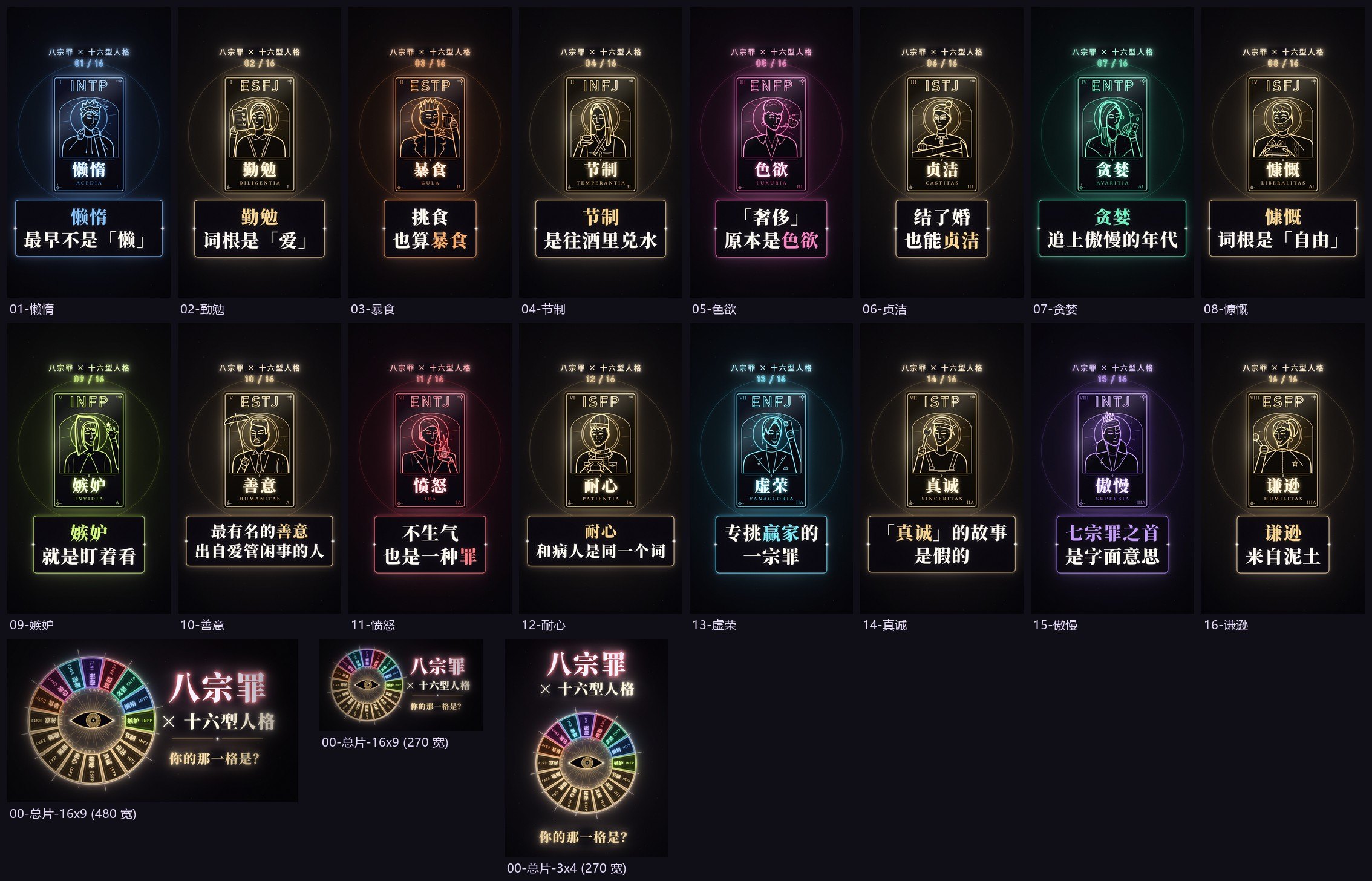
One score each
At first the sixteen shorts shared two theme tunes; later each sin and each virtue got its own piece. All sixteen use the same melody and the same grid (80 BPM, flip at 48 seconds) and change only instruments and character: sloth is a lazy electric piano dragging behind the beat, diligence is clock ticks and marimba, wrath is taiko and distorted bass, patience is piano notes spreading out one by one, and sincerity is a completely dry piano with no reverb. The sin episodes move from minor to major, the virtue episodes the other way.
For pride I later tried a version with a stronger build all the way to the flip. I could barely hear the difference, and in the end the original was released. A subtle change is not worth another round.
Reusable rules
- Make one card as a test first to settle the look, layout and pacing, then produce in bulk.
- Assemble characters from parameterised parts; sixteen types are sixteen sets of parameters.
- Write one shared timing sheet for picture and music first; they can be made separately and still align to a frame.
- Give information that has to be read (the radar chart) its own place and enough time, rather than flashing it over the subject.
- When two highlights appear together, rank them first, then consider the brightness of the colours themselves.
- In beat-synced music, do not drop out before every ordinary hit; keep silence for two or three key moments, and wind down before stopping.
- Source every fact separately, even the one you are surest of.
- Make changes large enough to be heard and seen; a change that subtle is not worth a round.