
vibe deconstruct (titled vibe解构 on screen) runs the opposite way from vibe construct: construct builds parts into a whole, deconstruct opens a thing up to see why it is the way it is. There are six in all: Chaoshan beef, and five films on the functions of plastic called Enchanting Plastic. Rendering and music are made as in construct, so that isn’t repeated here. The renderer, scores and checking tools were written by Claude Code; I chose the subjects, watched the cuts and made the calls. Every “feedback” in this post is a note I gave after watching.
Status: six films (9:16), finished between 2026-10-25 and 2026-10-30.
These are web versions compressed to 720p. The on-screen text is in Chinese only, there is no narration and no translated versions exist; on-screen lines quoted below are translated here. The on-screen text uses only statements checked episode by episode; Claude Code did the checking against public sources and no third party reviewed it, so the figures in the films are citations, not my own measurements.
How it differs from construct
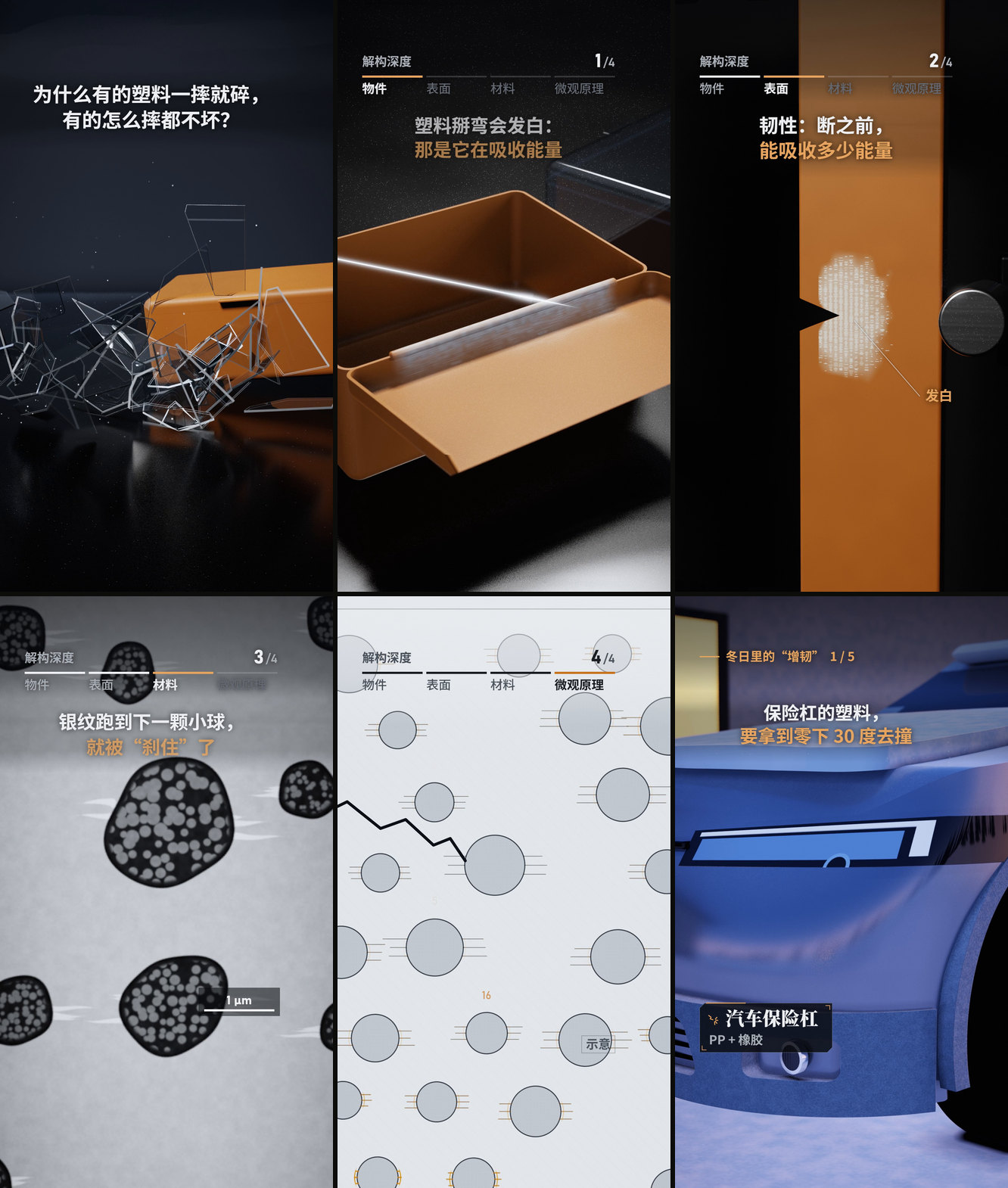
By deconstruct #02 I noticed the two series looked too alike: in both, things landed on drum hits, got labels and had an X-ray section. So from #03 on, deconstruct uses a grammar of its own:
| Construct | Deconstruct | |
|---|---|---|
| Direction | Parts to whole, building up | Whole to inside, cutting layer by layer |
| Subjects | Machines and structures: how they are made and move | Everyday objects, materials, food: why they are this way |
| Opening | A surprising fact, parts flying in | An everyday question, shown as a complete, familiar thing |
| Signature move | A part landing | A cut: a cut line opens the next layer |
| Signature readout | A part count | ”Deconstruction depth” 1/4 to 4/4: object, surface or part, material, microscopic principle |
| Picture | One style per episode | One texture per layer, so you can see the descent |
| Climax | It runs | The climb back: one continuous pull from the microscopic to daily life, ending on a plain sentence |
#01 and #02 predate this grammar and weren’t changed afterwards. #02 runs from material to product, so changing it would mean reordering the whole film.
Enchanting Plastic
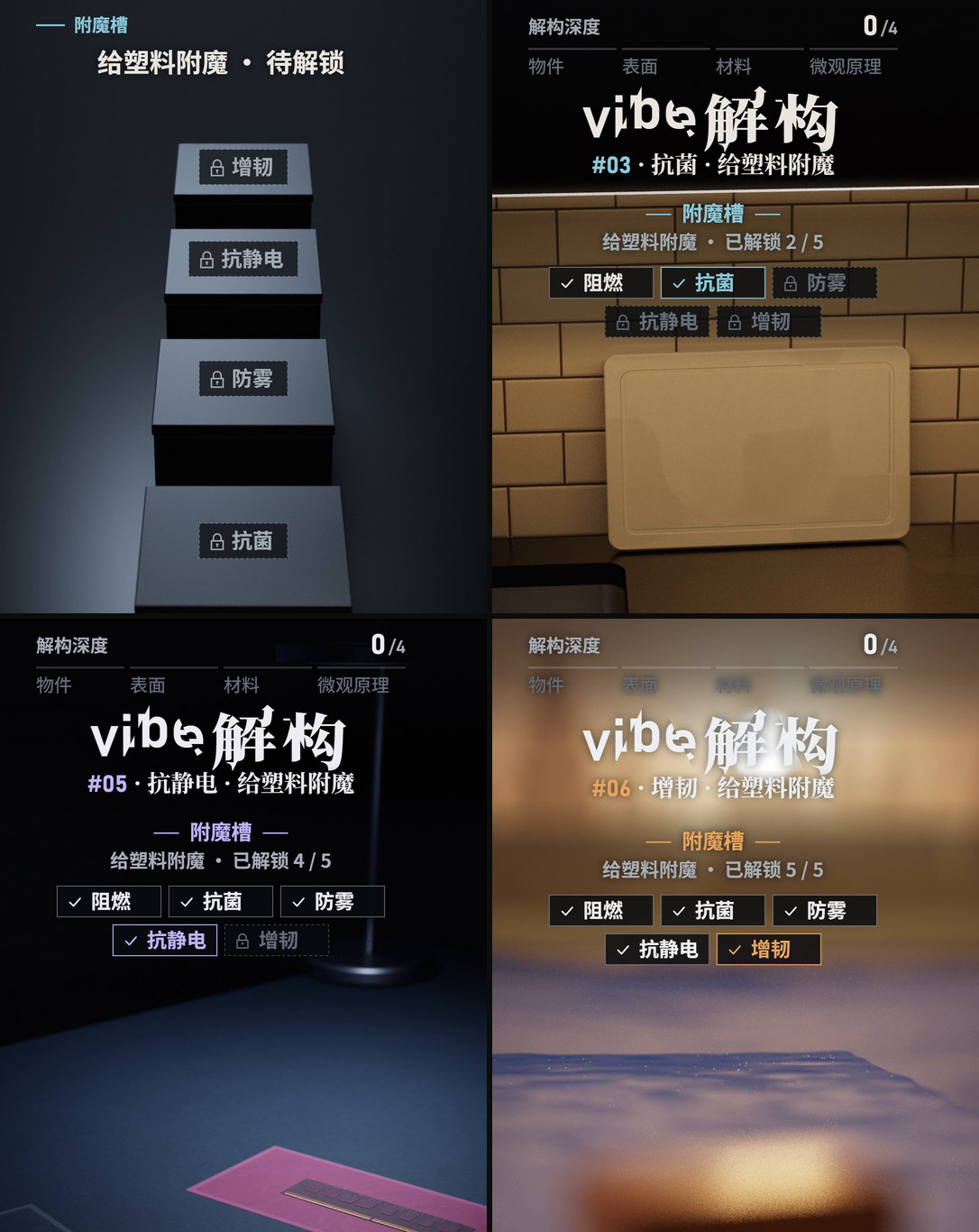
The last five films are a sub-series. A phrase like “flame-retardant plastic” felt too flat to me, so I borrowed enchanting from games: ordinary plastic is a piece of gear with no stats, and adding a function is one enchantment. Flame retardancy is “Fire Resistance”, antibacterial is “Lasting Aura”, anti-fog is “Passive Aura”, antistatic is “Building charges an escape route”, and toughening is “Splitting one critical hit into millions of small wounds”. The metaphor is only there to make it memorable; the films’ conclusions still follow the checked statements.
From #03 on, the end card has a five-slot checklist in the order flame retardancy, antibacterial, anti-fog, antistatic, toughening. Earlier slots are ticked, this episode’s slot unlocks on the end card’s strong beat, and later slots stay locked; the small heading reads “Unlocked 2 / 5”, reaching 5 / 5 by #06.
#02 is different. It was the first of the sub-series, before this checklist existed, and has only a teaser: four slots for antibacterial, anti-fog, antistatic and toughening stand on the display stage before the end card, under the heading “Enchanting Plastic · To unlock”. There is no slot for flame retardancy and no count, and the end card itself has only the title and the next-episode teaser.
The six films
01 Chaoshan beef
A warm food illustration: a dark wooden table and a clear broth pot. The cow is a matte faceted geometric sculpture, with no slaughter and no blood. The score is C minor boom-bap, with the cleaver as the snare and a synthesised Chaozhou zheng on the melody. The explanation is “Cut across the grain, and the shorter fibres are easier to chew”; the climax is swishing the beef, “Most slices, swished about 8 to 10 seconds”, with the note “Times vary by restaurant” on screen.
02 Flame retardancy
A restrained RPG codex: a dark display stage, item cards and skill cards, with the flame in the lead. The score is a heroic theme for a mixed orchestral ensemble, which turns from C minor to C major when the V-0 stamp lands. The conclusion is “Flame retardant doesn’t mean it won’t burn; when the fire leaves, it goes out by itself”. The film demonstrates the UL 94 vertical burn test; the two 10-second flame applications are sped up, and the picture marks them as sped up. The final codex runs from a charger to a circuit board: “The FR in FR-4 circuit boards stands for flame retardant”.
03 Antibacterial
The first film in the four-layer grammar. The question is “A chopping board cuts raw meat every day, so why haven’t bacteria grown on it?”. The picture moves from an evening kitchen, to macro shots of water drops and knife marks, to a greyscale cross-section like a micrograph, to a molecular diagram. The score is organic IDM in F major, and with each layer down the sound grows more muffled. The conclusion is “Antibacterial plastic doesn’t ‘kill everything’; it stops bacteria from growing on the surface”, and in the lab, compared with the same plastic without an antibacterial agent, there are “two fewer zeros”. The last line is “You still have to wash it”.
04 Anti-fog
The question is “Salad boxes in the fridge: why do some fog up and others don’t?”. Cold fridge light, backlit droplets and a film of water, a cross-section of plastic film, a molecular model like glass beads, and finally a pull back to a greenhouse at sunrise. The score is E minor folktronica with fingerpicked acoustic guitar and water drops. The conclusion is “Anti-fog doesn’t make the water vanish; it makes the water lie flat”, and the closing line is “Anti-fog is about seeing clearly, not keeping longer”.
05 Antistatic
The question is “Why are the bags that memory sticks come in pink?”, and the answer is “The pink is mostly an ID mark; the ingredient doing the work is colourless”. An electronics bench at night, charges stuck on a surface with nowhere to go, cross-sections of three antistatic methods, and finally a pull back to a coal mine conveyor belt. The score is C-sharp minor glitch-hop using the crackle of static. The conclusion is “Antistatic doesn’t stop charge from forming; it gives the charge a way out”, and the closing line is “Antistatic isn’t enough; it still has to be grounded”.
06 Toughening
The question is “Why do some plastics shatter when dropped, while others survive every fall?”. High-speed footage, photoelastic fringes, a greyscale “sea-island” structure like an electron micrograph, a game-damage diagram, and finally a pull back to a winter morning. The score is post-rock in B major, and the drums only fully open on the way back up. The explanations are “The hard plastic is the sea, the rubber balls are the islands” and “One big crack is split into countless small deformations”. The conclusion is “Toughened doesn’t mean unbreakable; it means harder to shatter”. The end-card checklist reaches 5 / 5.
What feedback changed
Too alike. The grammar above is the result of this note. It also brought a limit: deconstruct no longer assembles things piece by piece on a display stage, and its strong beats land on cuts, layer changes and reveals.
The checklist in every episode. The locked slots at the end of #02 were originally only a teaser. I asked for this checklist on every later end card, so viewers can see it fill up slot by slot. #03 and #04 were already finished and had their end-card frames replaced afterwards; #05 and #06 were made to the rule directly. #02 wasn’t changed.
A change of name. #02’s first title was “Enchanting Plastic: Fire Resistance”. It later settled on naming by function: the title says flame retardancy or antibacterial, “Enchanting Plastic” serves only as the sub-series tag, and terms like Fire Resistance and Lasting Aura stay in the films as flavour.