
vibe construct (titled vibe构筑 on screen) is a set of 3D shorts, each about one thing: its parts drop into place one by one on the beat, and once it is built, it runs. It starts with the bracket sets of a Tang-dynasty timber hall and ends with a blow moulding machine, fifteen objects in all. The renderer, scores and checking tools were written by Claude Code; I chose the subjects, watched the cuts and made the calls. Every “feedback” in this post is a note I gave after watching.
Status: fifteen films (9:16), plus one horizontal cut of #03 (16:9). The first was finished on 2026-10-24 and the latest on 2026-10-31.
These are web versions compressed to 720p. The on-screen text is in Chinese only, there is no narration and no translated versions exist; on-screen lines quoted below are translated here. The sister series running the other way is vibe deconstruct.
The structure of an episode
Every episode runs in the same order:
- An opening fact.
- An exploded view and the title.
- The build, chapter by chapter: labelled parts land on strong beats.
- One or two explanations, often as an X-ray or a cross-section.
- The object runs. This is the climax of the film.
- An end card: the title and a teaser for the next episode (#15 has no teaser).
Length follows content: the first two are 48 seconds, the rest between 72 and 98. The masters are vertical 1080 × 1920 at 30 fps, and each ending joins back to its opening so the film can loop.
How they are made
Each film is a web page in which any frame is determined by time alone; a headless browser captures it frame by frame and ffmpeg encodes the result. That much is the same as in the earlier explainer shorts. The difference is the picture: the 3D here is computed by a hand-written WebGL2 SDF raymarching renderer, with no external libraries and no downloaded models, images or fonts. Text uses fonts already installed on the machine.
Each score is written separately and synthesised in code, without samples. The sound of a part landing is tuned to the chord at that moment, and the strong beats in the picture are aligned to the frame using the score’s cue sheet. No two films share a look or a music genre.
The objects are generic designs. They copy no particular product and show no brands or logos, with two exceptions worth stating: the hall in #01 is modelled on the East Hall of Foguang Temple (857) but is not a measured reconstruction, and the lens structure in #03 follows the published data of a real lens.
What can be measured and what rests on judgement are kept apart. The on-screen text uses only statements checked episode by episode; Claude Code did the checking against public sources and no third party reviewed it, so the figures in the films are citations, not my own measurements. Those labelled as typical estimates or as full-load theoretical values are estimates. Checking tools verify whether the picture changes on the frame of each strong beat, the loop seam, flicker, and whether text stays inside the phone-safe area. Whether it looks good is my judgement.
A full render of one film takes anywhere from just over ten minutes to more than three hours: #01 took about 18 minutes and the first version of #13 about 3 hours 20 minutes.
The fifteen films
The next episode teased on an end card is sometimes in the other series.
01 Dougong
Wireframe blueprints on deep blue. Only the part currently landing glows amber, and close-ups switch to opaque white models. The score is a light D major pentatonic groove led by kalimba and flute. The explanation is “Blocks and arms lock with mortise and tenon, not nails”; at the end a scan line turns the wireframe into a solid hall.
02 Mechanical keyboard
Bright product-launch studio lighting, an aluminium case and matte keycaps. The only bright colour is one orange Esc. The score is A minor lo-fi house with keycap sounds as drums. It opens with “A mechanical keyboard with 87 keys hides 87 springs”, and the X-ray says “Press about 2 mm and the contact closes”; at the end the keyboard types by itself, each keypress a note of the melody.
03 Camera
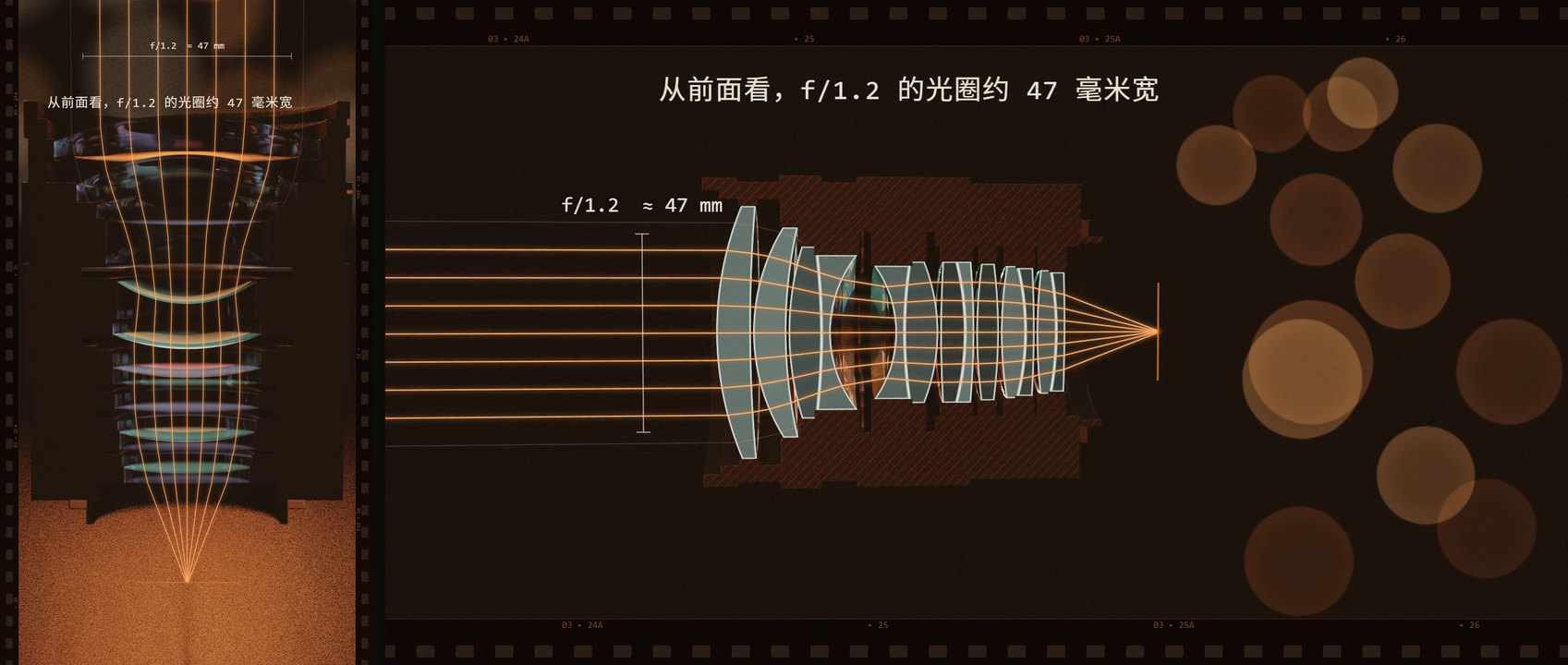
Darkroom red safelight and film-frame borders, with an E minor cinematic minimalist score for strings and piano. The focus is the shutter and the lens: “Faster than 1/180 s, the two curtains sweep past as a slit” and “13 elements in 8 groups”. At the end the shutter fires, and what it captures is this film’s opening shot, developing like a print.
The horizontal cut came later, because I felt the vertical frame was limiting this one. The score and length are unchanged, and the 32 shots were rearranged.
04 Inline-six engine
A pure black car-advert studio with reflections from long strip lights sweeping across the metal. The only red in the film is the valve cover. The score is dark electronic music in F minor. The explanation is balance: “Six crank throws in three pairs, 120° apart” and “The front three cylinders mirror the rear three, balanced by design”. The running section after 0:54 is a remade second version; the reason, and a note on the coin, are at the end of this post.
05 Twin-screw extruder
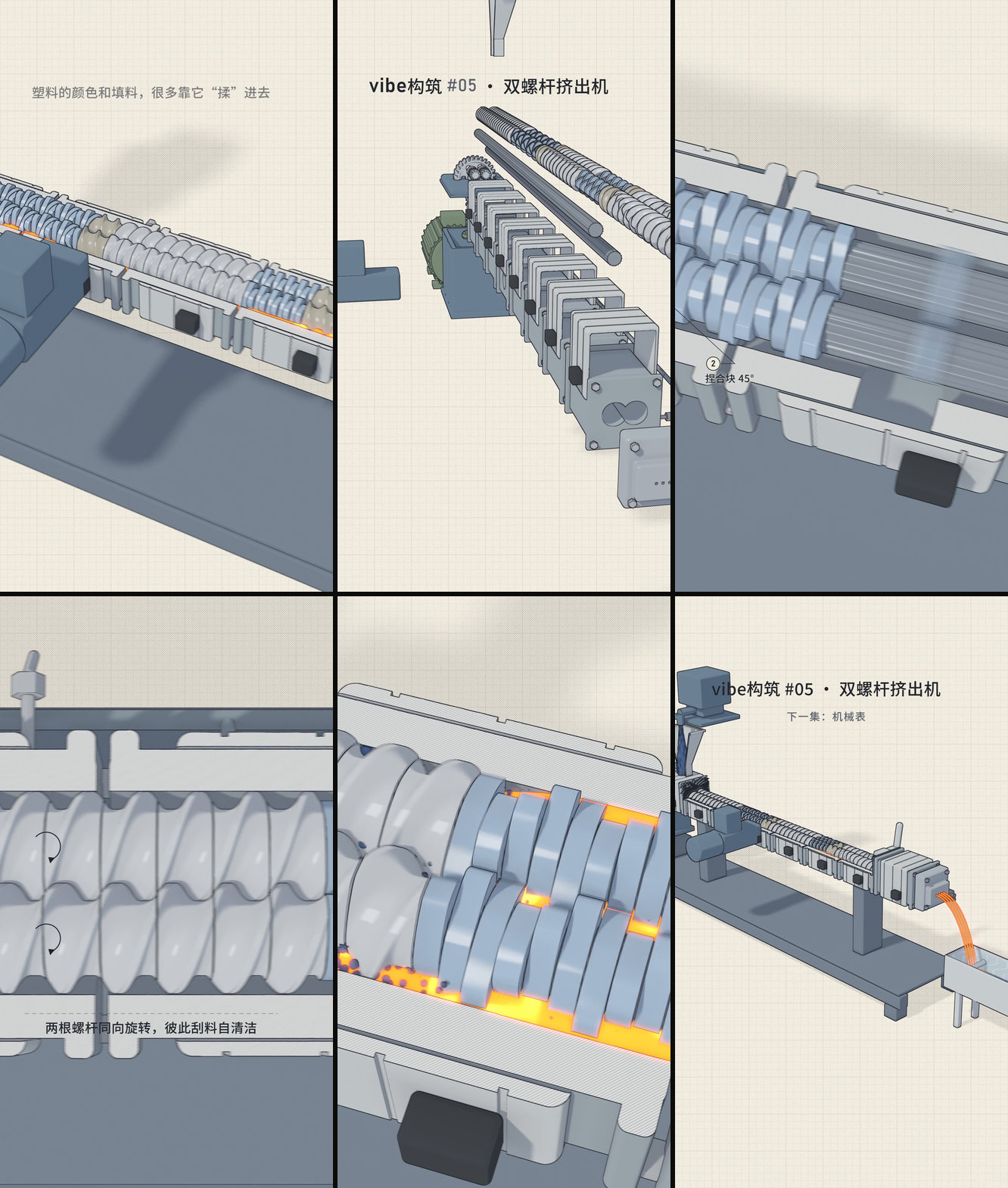
A technical cross-section illustration on beige paper, in which the melt is the only warm colour. The score is drum & bass at 172 BPM, half-time during the build and full speed only once it runs. The explanations are “The two screws turn the same way and wipe each other clean” and “The larger the stagger angle, the less it pushes and the harder it kneads”. At the end the strands are cut into pellets, and the pellets form #05.
06 Mechanical watch
Macro shots on midnight blue: perlage, Côtes de Genève, blued screws and ruby jewels. The score is neo-baroque chamber music in B minor. “8 beats a second, exactly sixteenth notes at 120 BPM”, so the watch’s ticking sits on the music’s grid. At the end the hands stop at 10:10.
07 Grand piano
One warm spotlight on a concert hall stage, a black lacquer case and a golden cast-iron frame. The score is neoclassical piano, with the piano itself in the lead. The explanation is the action: “Once the jack lets go, the hammer flies to the string on inertia”, and the double escapement of 1821 means “The key can strike again before it has fully risen”. At the climax the piano plays the score’s theme by itself, and each key pressed in the picture is the note you hear.
08 Espresso machine
A café counter in morning light, stainless steel and coffee brown. The score is bossa nova in B-flat major, with tamping, locking the portafilter and steam tuned to the chords and joining the accompaniment. The explanations are “Extraction pressure is about 9 bar”, “Water at about 90–96 °C, not boiling” and “The so-called ‘oils’ of the crema are mostly carbon dioxide bubbles”. It ends with a cup of latte art.
09 Music box
Deep green velvet and brass under one warm lamp. The score is a lullaby-like chillwave waltz, with the music box itself in the lead. “Each pin is one note”: the positions of the film’s 136 pins are taken from the score’s data, and “The cylinder is a program written once and for all”. At the end the spring runs down, the governor fan slows, and the tune slows and stops.
10 3×3 cube
Bauhaus poster style: beige paper, primary printing colours, hard shadows. The score is math rock in E major, in 7/8 and 5/4, with the turning sounds as percussion. It opens with “43 quintillion scrambles, at most 20 moves” (a half turn counts as 1 move). The climax is a position that “Looks tidy, yet takes at least 20 moves”, solved one move per beat: “For the first 18 moves, not one whole face” and “The last move, all six faces”. The cube’s state is really simulated, and every move is a legal turn.
11 Underwater pelletiser
A stainless steel machine. Open the cutting chamber and there is a water-blue world and amber melt. The score moves gradually from F-sharp minor dub techno to a more driving techno. The explanations are “The die plate is over 200 °C, the water against it only a few tens of degrees” (taking polyethylene as the example) and “Just cut, it is still melt, and surface tension pulls it into a ball”. The film also compares strand, water-ring and underwater pelletising.
12 Injection moulding machine
A bright workshop, shot tilt-shift like a miniature. The score is D minor funk / disco-house with a two-second bar, exactly one cycle of the bottle-cap mould from the opening. The explanation is the screw’s two jobs: first it turns and melts the material, which pushes it back, and then “One push forward, and it shoots into the mould like a syringe”. At the climax each cycle changes to a different product, which is also this film’s problem; see the end of this post.
13 Custom water cooling
An open panel hangs on a charcoal wall like an exhibit, the coolant is an opaque ice white, and only at power-on does a cyan edge light appear. The score is synth-pop in A-flat major. It opens with “For the same volume, water holds over 3,000 times the heat of air”, and concludes “However it circulates, the water can’t get cooler than the room”: in the end, water cooling still hands the heat to the air.
14 Internal mixer
A heavy-industry workshop on the night shift. The steel is a cold grey, and only the rubber compound and what it touches take thermal-camera colours. The score is drift phonk, with the ram and the drop door joining the groove. The explanations are “The heat doesn’t come from a heater, it comes from the rotors’ own mixing” and “So instead of being heated, it has to be cooled all the time”. The climax is the cycle of charging, pressing the ram, mixing and discharging, followed by where the compound goes: tyres, shoe soles, seals, hoses and conveyor belts.
15 Blow moulding machine
A blue background like a summer drinks advert, with hard light passing through clear bottles and leaving caustics on the floor. The score is tropical house in E-flat major, with exhaust and mould-clamping sounds as percussion. It continues from #12: “The injection-moulded ‘test tube’ is blown into a bottle”. The explanations are “A low-pressure pre-blow first, then a high-pressure burst to fill the mould” and “A wall a few millimetres thick ends up a few tenths of a millimetre”. The end card has no teaser.
What feedback changed
Plastic toy. The first sample used realistic materials and looked to me like a plastic toy: almost real, and for that reason the most obviously fake. So #01 went in the direction code does well, a precise and clean digital space. Later films either carry real materials all the way or commit to a clear graphic style.
Light pollution. My verdict on the first stills in the digital style was light pollution. They were changed to restraint: only the part landing glows, parts already in place fade to thin lines, the background is darkened and the colours are reduced. Each later film changed its look, but the restraint stayed.
Landing sounds out of key. In the sample’s first score, the landing sounds and the music weren’t in the same key, and it grated. Since then every landing sound has been tuned to the chord at that moment, so the build itself is playing the music.
Subject melting into the background (#03). I liked the darkroom tone, but the camera melted into the background. A thin, cool rim light was added and the background was given a falloff.
A running section that only passed (#04). The build was the best in the series at the time, but once it ran, the thrill, the pacing and the picture were only passable. This note changed how every later film was made: the climax has to be the best-looking part of the film, with a cut or a clear camera move every bar, macro shots, and a visible result at the end. #04 itself later had everything after 0:54 remade: the starter gear, the cylinders firing in turn, macro shots of the valvetrain and pistons, a rev readout climbing to 6800 rpm, and a coin standing on the valve cover. The coin is meant to express “balanced by design”, and it is only a visual suggestion: I found no source for whether it would stay standing at this speed, and it wasn’t measured.
Products flashing by (#12). At the climax, the next round starts before you can make out the product. The film itself wasn’t changed, but it produced a rule: each product needs a readable hold of at least about 1 to 1.5 seconds. “A cut every bar” doesn’t mean “a new thing every bar”. By #15, each of the five bottles holds for two bars, about 4.27 seconds.
Miscounted radiators (#13). The first version drew a row of four 240 radiators, with an empty middle in the panel and the wrong proportions. What I had actually meant by “4 to 5” earlier was the number of fans, not radiators. The second version has one 480 radiator with four fans, the panel was scaled down to fit the parts, the score was left alone and the whole film was re-rendered.
A flat ending (#14). The last 16 seconds of the first version were on the flat side. The second version remade them: a tracking shot along a production line, a new generic twin-screw extruder, and an end card landing in front of a wall of tyres.
Silence. This rule carries over from Eight Sins: no dropout before ordinary strong beats, the music runs straight into them, and real silence is kept for two or three key moments. #10 takes one breath only before the solve begins, and #14 only before the first charging cycle.